Gout in Foot: Why the Big Toe Is Hit First, What a Flare Feels Like & When to See a Doctor
Gout in the Foot: Why Your Big Toe Is Target Number One
You go to bed fine. You wake up at 3 a.m. feeling like someone slammed a door on your big toe — except nobody touched it. The joint at the base of the toe is swollen, hot, shiny, and so tender that even the weight of your bedsheet feels unbearable. If that scene sounds familiar, you have met podagra: gout in the big toe joint, the most classic presentation of gout there is.
Gout loves the foot. The first attack of gout strikes the first metatarsophalangeal joint — the knuckle where your big toe meets the rest of your foot — in 56–78% of patients, and the joint gets involved at some point in 59–89% of people with gout. The ancient Greeks named the condition podagra, literally “foot-grabber,” and two thousand years of medicine have confirmed their observation. Here is why the foot is gout’s favorite target, what a flare feels like stage by stage, and when foot pain means you should see a doctor.
Why Gout Targets the Foot First
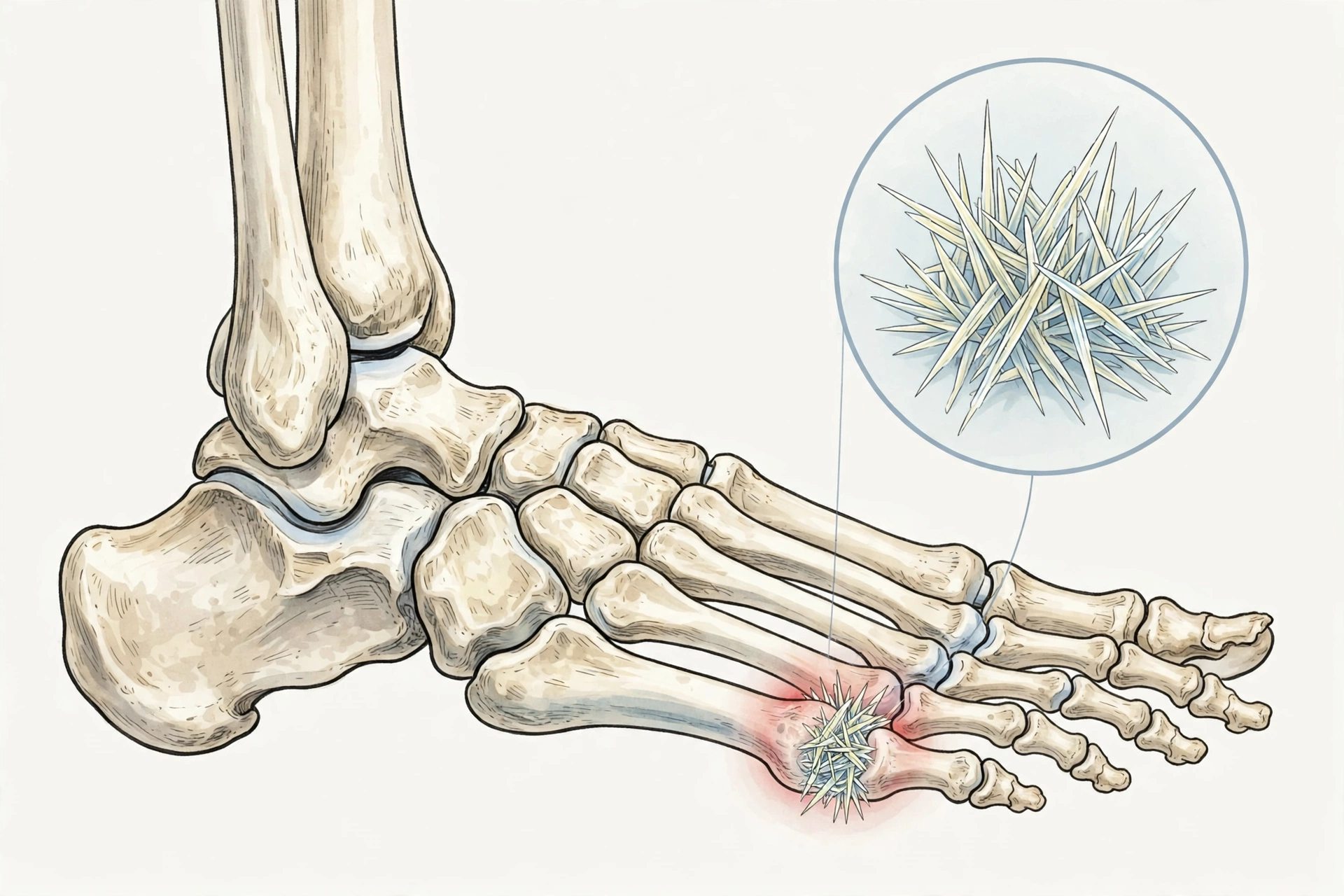
Gout is a crystal disease. When uric acid builds up in the blood (hyperuricemia), it can precipitate out as sharp, needle-like monosodium urate crystals that settle in and around joints. Those crystals trigger an immune attack — the inflammation is your body trying to fight off shards it cannot digest. But why do the crystals keep choosing the foot?
1. The foot runs colder than the rest of you
Urate dissolves less easily as temperature drops. Your big toe sits at the farthest point from your heart, so it runs slightly cooler than your body’s core. That small temperature difference matters: crystals nucleate — are “born” — more readily in cooler joint fluid. This is one reason gout prefers distal, peripheral joints (feet, ankles, fingers) and almost never bothers the warm central joints like the hips, shoulders, or spine.
2. Your feet take a beating every day
The joint at the base of the big toe carries a remarkable share of your body weight with every step. Repetitive pressure, stubbed toes, tight shoes, and long days on your feet create minor mechanical shocks. Laboratory work shows that physical agitation of urate-saturated fluid speeds up crystal formation, and doctors have long noticed that a stubbed toe can trigger an attack in the very same joint. Your foot is simply the body part most likely to get knocked around.
3. Osteoarthritis sets the table
The big toe joint is also a common site of osteoarthritis — the wear-and-tear kind. Research shows monosodium urate crystals deposit more readily in damaged cartilage, and clinical studies find a strong association between joints that show osteoarthritis and joints where gout attacks occur. Damaged cartilage may act as a rough surface where crystals find it easier to take hold. When osteoarthritis and gout overlap at the same joint, the big toe becomes gout’s most reliable target.
What a Gout Attack in the Foot Feels Like, Stage by Stage
Most people experience their first gout attack as a single joint going haywire overnight. Here is the typical timeline, based on how doctors describe the classic flare:
The hours before: the warning
Some people get a subtle heads-up: the toe joint feels a little stiff, tingly, or achy in the evening. Many get no warning at all. The onset is famously abrupt — most people describe falling asleep fine and waking up in agony.
The onset: sudden, severe pain (usually at night)
The attack typically starts between midnight and morning. Pain ramps up fast — research describes most attacks reaching peak intensity within 24 hours, and Mayo Clinic notes the pain is often worst within the first 8 to 12 hours after it starts. The joint feels like it is burning. People compare it to a broken bone, a severe burn, or being bitten — ordinary descriptions fail because the pain is so disproportionate to what the joint looks like from the outside. Even a bedsheet brushing the toe can feel intolerable.
The peak: heat, swelling, and redness
At full flare, the joint is swollen, hot, and red (though redness may be harder to see on darker skin). The toe may look puffy and shiny, and the joint feels rigid — bending it is nearly impossible. This peak usually lasts a day or two. Touching the joint, putting on a shoe, or bearing weight ranges from difficult to impossible.
The comedown: lingering soreness
After the worst pain fades, the joint often stays tender and slightly swollen for days to a few weeks. The skin over the joint may itch or peel as the attack resolves. An untreated attack usually clears completely within one to three weeks. Then comes the quiet stretch — the “intercritical period” — which can last months or years. But the uric acid problem behind the attack has not gone away, and without management, attacks tend to come back more often, last longer, and spread to new joints.
Foot Gout vs. Gout in Other Joints
The foot dominates gout’s geography, but it does not own it. Here is how the numbers break down across the body:
- Big toe (first metatarsophalangeal joint): the first attack lands here in 56–78% of patients; involved at some point in 59–89%
- Mid-foot: involved in 25–50% of patients
- Ankle: involved in 18–60% of patients
- Upper limb (wrist, elbow, fingers): involved in only 13–46%
- Finger joints: only 6–25%
Gout can also settle in places people do not expect: the Achilles tendon at the back of the ankle, the fluid sacs (bursae) around the elbow and knee, and even the ears in long-standing disease. As gout progresses over years, attacks may involve several joints at once (polyarticular gout) rather than one toe at a time. Wherever it lands, the mechanism is the same: crystals, inflammation, pain.
One thing worth knowing: crystals can sit quietly in joints that have never flared. Studies have found urate crystal deposits in the big toe joints of gout patients who had never experienced an attack there. The absence of pain does not always mean the absence of crystals — another reason blood uric acid levels matter more than how your toe feels today. Learn what your uric acid test result actually means so you can track the number behind the flares.
Tophi: The Long-Term Foot Problem
In gout that goes unmanaged for years, urate crystals can build up under the skin into firm, chalky lumps called tophi. The toes, the Achilles tendon, and the fingers are favorite spots. Tophi usually do not hurt on their own, but they can swell and turn tender during flares, interfere with shoes and walking, and in advanced cases break through the skin and leak a gritty white paste — the crystals themselves. Chronic gout can also permanently damage joints, narrowing the space where the bones meet and stiffening the toe for good.
Tophi are also the clearest visible proof that gout is a whole-body chemistry problem, not a foot problem. The foot is just where the chemistry shows up first. If you spot firm lumps around your toes or heels, treat them as a signal to get uric acid under control, not something to ignore because they do not hurt. See our full symptoms guide for the complete picture of how gout presents.
When Foot Pain Means “See a Doctor”
Not every sore toe is gout — bunions, arthritis, fractures, and infections can all mimic it — so a first attack deserves a proper medical diagnosis. Here is the guidance major medical institutions give:
- See a doctor if: you have sudden, intense joint pain for the first time, or your usual gout treatments stop working. A blood test measuring uric acid, and sometimes a sample of fluid drawn from the joint to look for crystals under a microscope, confirms the diagnosis. Joint fluid analysis is the gold standard — it finds the actual crystals.
- Seek urgent care if: the pain is rapidly getting worse, you develop a very high temperature or feel hot and shivery, or you feel sick and cannot eat. A hot, inflamed joint plus fever can mean a joint infection, which is a medical emergency — infections need different treatment from gout flares.
Also see a doctor even after the pain is gone. As Stanford’s gout guidance puts it, the uric acid buildup that caused the attack can keep harming your joints silently between flares. One calm toe does not mean the chemistry is fixed. Our FAQ answers common questions about testing and diagnosis.
What Helps a Foot Flare — and What Prevents the Next One
During an attack, the immediate goals are to calm the inflammation and protect the joint:
- Rest the foot. Stay off it as much as you can; every step grinds inflamed tissue.
- Ice it. A cold pack wrapped in a cloth, 15–20 minutes at a time, dulls pain and swelling.
- Elevate it. Raising the foot above heart level helps fluid drain away from the joint.
- Stay hydrated. Water helps your kidneys flush uric acid — it will not stop a flare in progress, but dehydration concentrates uric acid and makes everything worse.
For the longer game, fewer crystals mean fewer flares, and diet is one lever you control. Flares are often triggered by purine-heavy eating and drinking: organ meats are the heaviest hitters in our database (beef liver measures 197 mg of purines per 100g), roasted chicken breast sits at 178.5 mg per 100g, and beer — the alcohol most strongly linked to gout — measures around 8.5 mg per 100mL for a regular lager, plus alcohol itself slows uric acid excretion. Cutting back on these during vulnerable periods is one of the simplest preventive moves available. Check any food’s purine value in our free 38,078-food database before it lands on your plate.
A structured low-purine eating pattern helps more than sporadic caution. Our diet plan walks through the framework — the foods to favor, the ones to limit, and how to build gout-friendly meals day after day. And small daily habits compound: people are often surprised how much difference consistent hydration and a morning routine make. Coffee, for example, is linked in studies to lower uric acid levels — one more reason your morning cup may be doing quiet work for your joints.
One caution: do not start, stop, or change any gout medication on your own during a flare. Urate-lowering therapy is a long-term medical decision, and timing matters — starting it mid-flare can actually make the attack worse. That call belongs to your doctor.
References
- Roddy E. Revisiting the pathogenesis of podagra: why does gout target the foot? Journal of Foot and Ankle Research 2011;4:13. Full text on PubMed Central — supports the temperature, mechanical trauma, and osteoarthritis explanations for the big toe’s vulnerability, plus the 56–78% first-attack statistic.
- Mayo Clinic. Gout: Symptoms and causes. mayoclinic.org — supports the symptom description, the 8–12 hour pain peak, and when to see a doctor.
- NHS. Gout. nhs.uk — supports the 1–2 week untreated attack timeline and the urgent-care warning signs.
For education only — not medical advice. Discuss diet changes with your doctor.