Early Stage Gout Symptoms: The Warning Signs Before Your First Flare
Gout has a strange way of beginning: quietly. For months or even years, uric acid can pile up in your blood without causing a single twinge. Then, one night, a joint explodes with pain. If you are searching for early stage gout symptoms, you are probably asking the right question at the right time — here is what the first warning signs actually look like, and how to tell them apart from everyday aches.
The first thing to understand: high uric acid has no symptoms
This surprises almost everyone. High uric acid levels on their own cause no symptoms — the first symptom most people ever experience is an acute arthritis episode, typically in the big toe. As Mayo Clinic puts it, gout symptoms “almost always happen suddenly, often at night.”
Uric acid is a waste product your body makes when it breaks down purines, natural substances found in every cell of your body and in many foods. When levels climb too high, the uric acid forms sharp, needle-like crystals that lodge in your joints. The moment your immune system reacts to those crystals, inflammation erupts — and that eruption is what you feel.
This is why a blood test matters more than symptom-watching in the very early stage. If you have risk factors — a family history of gout, regular alcohol use, a diet heavy in purines, excess weight, or certain blood pressure medicines — knowing your number beats waiting for pain. Check our guide to the normal uric acid range to see where your result should sit for men, women, and kids.
The hours-before warning: what many people feel before a flare
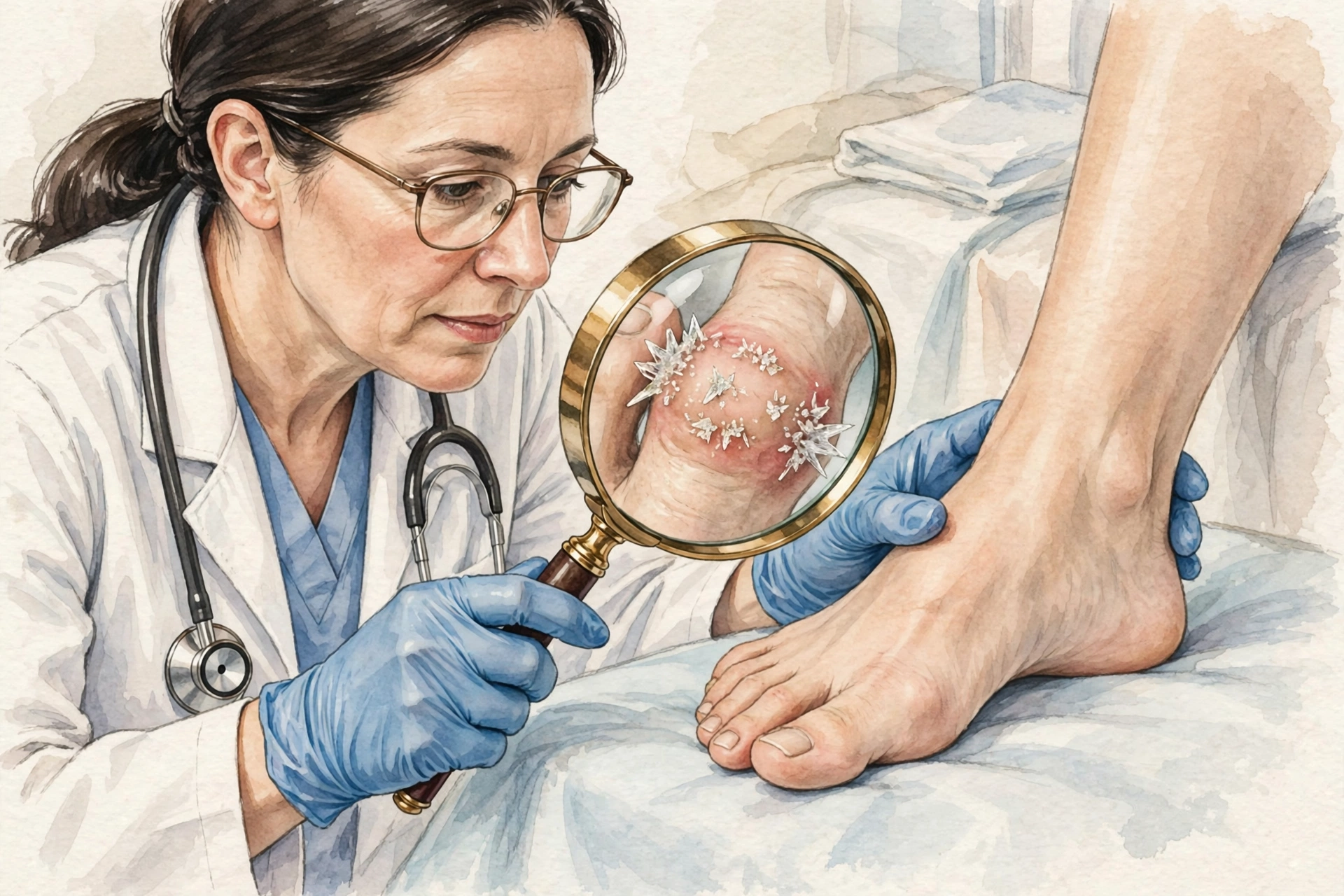
Here is the part most articles skip. While a full flare arrives suddenly, many people with gout report a short “prodrome” — a set of subtle signals that show up hours, sometimes a day, before the severe pain hits. Recognizing your own pattern gives you a chance to act before the worst of it.
Watch for these in a joint you have had gout in before — most often the big toe, ankle, or midfoot:
- Tingling or a “something is about to happen” feeling. A vague buzzing or pins-and-needles sensation around the joint, with no injury to explain it.
- Mild warmth out of proportion to the discomfort. The joint feels warm to the touch before it looks or feels seriously wrong.
- Tightness or pressure. The skin over the joint feels stretched or full, like a balloon slightly over-inflated. Shoes may suddenly feel tighter on one foot.
- A dull ache or random twinges. Brief, sharp pangs that come and go. People brush these off as a long day on their feet or “wear and tear.”
- Mild swelling or stiffness. Slight puffiness you might not notice unless you look for it, or a toe that resists bending the way it did yesterday.
- Itching over the joint. An odd but commonly reported itch right where the flare will land.
Be honest with yourself about these: they are patient-reported signals, not a clinical rule. Some flares arrive with zero warning at all — one minute you are asleep, the next your toe is on fire. But if you have had gout before, learning your personal prodrome is genuinely useful: when you feel it, rest the joint, hydrate well, and get your prescribed flare medicine started as early as your doctor advised.
What a first full flare actually feels like
If you have never had one, here is a description in plain words — because a first flare is frightening, and knowing what is happening helps.
It usually strikes at night or in the early morning. The pain is intense and focused on one joint, most often the base of the big toe. Mayo Clinic describes the worst pain arriving within the first 8 to 12 hours, with the joint becoming hot, swollen, and so tender that the weight of a bedsheet on it feels like too much pressure. The skin over the joint can look red or purplish — and Mayo notes that this redness may be harder to see on Black or brown skin.
The Arthritis Foundation adds the typical arc: attacks usually peak after 12 to 24 hours, then slowly fade on their own whether they are treated or not. The worst pain eases, but a lingering ache can hang around for days or even a couple of weeks.
For a fuller picture of why the foot takes the hit first and what each stage feels like, read our guide to gout in the foot.
Where early gout shows up first
Gout has a favorite starting point: the big toe. The big toe is the joint most affected, and that first big-toe attack even has its own medical name — podagra. But early gout is not locked to one spot. It can also begin in the midfoot, ankle, or knee, and occasionally in the wrist or fingers. The Arthritis Foundation notes that people with osteoarthritis in their fingers may experience their first gout attack in a finger joint.
Most early attacks hit a single joint at a time. If the same spot flares again and again, that is a classic early pattern — gout often revisits the joint where it started before spreading to others.
What early gout gets mistaken for
Before the first full flare, people commonly attribute the warning signs to something ordinary:
- A minor sprain. A sore ankle with no clear injury gets filed under “I must have twisted it.”
- A long day on your feet. Aching feet after standing all day seem normal — until one foot keeps aching after rest.
- “Wear and tear.” Brief twinges in a toe or knee get blamed on age or old sports injuries.
- A bunion. The base of the big toe is exactly where bunions form, so a hot, tender bump there can confuse people for weeks.
- An infection. A red, swollen, hot joint can look infected, and some people land in urgent care convinced they have a wound infection.
The difference that tips it toward gout: the attack is sudden and explosive rather than gradual, it often arrives at night, and it concentrates in one joint — usually the big toe. Our gout symptoms page walks through the full pattern in more detail.
How early gout progresses if you do nothing
The first attack usually resolves on its own, and the gap before the next one can be months or even a couple of years. That long quiet stretch fools people into thinking it was a random event. It usually is not.
Left unmanaged, gout follows a predictable escalation. Attacks come back more often — what was once a year becomes twice a year, then quarterly. They can last longer, hurt more, and start involving more joints. Over many years, uric acid crystals accumulate into hard, chalky lumps under the skin called tophi, which can damage bone and cartilage. Mayo Clinic also warns that urate crystals can collect in the urinary tract and cause kidney stones.
The key point: the flare fading is not the same as the problem leaving. The crystals stay in the joint and keep triggering attacks until uric acid levels come down and stay down. That is why early action matters more than toughing it out.
What early action actually does
Acting early is not about panic — it is about information. The NHS advises seeing a GP at your first gout symptoms. Your doctor may ask about your diet and alcohol, order a blood test to measure uric acid, and, if the picture is unclear, draw a small sample of joint fluid to look for crystals under a microscope — which the Arthritis Foundation calls the best way to diagnose gout.
Once gout is confirmed, the goal is straightforward. The American College of Rheumatology recommends a treat-to-target approach: you and your doctor pick a uric acid goal — usually below 6 mg/dL — and adjust treatment until you reach it. Getting below that line is what stops new crystals from forming and lets old deposits dissolve.
Food and habits play a supporting role from day one. Dehydration and a very large meal can both trigger an attack, and the NHS lists drinking plenty of fluids, keeping alcohol-free days, and avoiding lots of sugary drinks among the lifestyle steps that help prevent attacks from coming back. When you swap foods, use real numbers, not guesswork — measured values from our food list database tell the story: canned sardines measure 399 mg of purines per 100g, raw anchovies 411 mg/100g, beef liver 197 mg/100g, and roasted chicken breast 178.5 mg/100g. Regular beer measures 8.48 mg per 100mL (dark beer 13.51 mg per 100mL). The gentler end of the database looks very different: 2% milk measures just 0.6 mg/100g, tofu 20 mg/100g, and raw mushrooms 46.9 mg/100g. Build your eating plan around the safer foods with help from our gout diet plan.
See a doctor right away if
Most gout attacks can be managed at home with rest and the plan your doctor gave you. But certain signs mean do not wait:
- Sudden, intense joint pain you have never had before. Mayo Clinic advises calling a healthcare professional at the first such attack — gout that goes untreated can damage a joint.
- Fever with a hot, inflamed joint. Both Mayo Clinic and the NHS flag this combination as a possible joint infection, which is a medical emergency — seek care immediately.
- The pain keeps getting worse despite the treatment that usually helps you.
- You feel generally ill — sick, unable to eat, or running a high temperature alongside the joint pain.
If any of this sounds familiar, the answers to the most common questions are collected on our gout FAQ page.
References
- Mayo Clinic — Gout: Symptoms and causes — sudden intense pain peaking in 8–12 hours, hot swollen joints, the bedsheet-level tenderness, tophi and kidney stone complications, and when to call a doctor.
- Arthritis Foundation — Gout: Symptoms, Diagnosis, and Treatment — flare arc of 12–24 hours, needle-like crystal mechanism, joint fluid analysis as the best diagnosis, and the ACR treat-to-target goal below 6 mg/dL.
- NHS — Gout — symptom list, 1–2 week attack duration, seeing a GP at first symptoms, common triggers (alcohol, dehydration, injury, illness, medicines), and fever-plus-joint-pain as an urgent sign.
For education only — not medical advice. Discuss diet changes with your doctor.