Cherries and Gout: Do Cherries Lower Uric Acid? What the Studies Actually Show
If one food had to carry the banner for “foods that help gout,” it would be cherries. You will find them recommended in NHS diet sheets, arthritis forums, and practically every listicle about gout-friendly eating. But recommendations only matter if the research behind them holds up. So this article does something most cherry listicles skip: it checks the actual studies, lays out what they found, admits what they did not prove, and tells you exactly how the numbers compare with what our purine database actually measures.
What the studies actually found
The most-cited study on cherries and gout comes from a Boston University team led by Dr. Yuqing Zhang. Published in Arthritis & Rheumatism in 2012, it followed 633 people with gout for a year. When participants ate cherries (fresh cherries or cherry extract) during any two-day window, their risk of a gout attack in the following days dropped by 35% compared with two-day windows without cherry intake. Cherry extract on its own showed a similar effect. And when cherry intake was combined with allopurinol, the standard uric-acid-lowering drug, attack risk fell by 75% compared with using neither.
One serving in that study meant half a cup of fresh cherries – roughly 10 to 12 cherries. The benefit kept increasing with more cherries up to three servings over two days, then leveled off. Importantly, the protective effect held up after the researchers accounted for sex, obesity, purine intake, alcohol use, diuretics, and anti-gout medications.
Other studies point the same direction, though most of them are small. In one early trial, volunteers who ate 45 fresh Bing cherries lowered their blood uric acid by 14% within hours. In a 2019 study, people who drank 8 ounces of diluted tart cherry juice concentrate every day for four weeks showed a significant drop in uric acid – and a nearly 20% drop in C-reactive protein, a common marker of inflammation. A small retrospective study of 24 gout patients found 50% fewer flares among those who took one tablespoon of tart cherry extract twice a day for four months.
In 2019, researchers reviewed six cherry-and-gout studies and concluded that tart cherry juice was consistently linked with lower serum uric acid and less severe, less frequent gout flares. They also added the caveat every honest review adds: the studies used different cherry forms and doses, and larger, better-controlled trials are still needed.
Why cherries might work: anthocyanins
The leading explanation is not purines – it is color. Cherries get their deep red color from anthocyanins, plant pigments with strong antioxidant and anti-inflammatory properties. Anthocyanins appear to interfere with the inflammatory pathways that make a gout attack so painful, and may also help lower uric acid or slow its formation. Cherries also supply vitamin C and quercetin, a flavonoid that researchers think may dampen uric acid production. The Arthritis Foundation notes that cherries carry more anthocyanins than most other fruits, including blueberries.
That matters for one simple reason: cherries do not earn their gout reputation by being low in purines. They earn it through what their pigments appear to do to inflammation and uric acid handling. Which brings us to the honest data question.
What our purine database actually says about cherries
Our food database holds 38,078 entries, and I looked for measured purine values for fresh cherries before writing this article. Here is the honest answer: our database does not have a measured purine value for fresh sweet or tart cherries. The cherry entries we do have are unmeasured branded products (cherry juices, cherry-flavored drinks) and canned-fruit entries with calorie data but no purine measurements.
That gap is worth stating plainly rather than filling it with a made-up number. What we can say with certainty is that cherries are fruit, and fruits as a category are among the lowest-purine foods that exist – far from the measured red-zone values in our database, such as dried raw lentils at 222 mg/100g or the moderate band around chicken breast at 178.5 mg/100g and ground beef at 133.3 mg/100g. Cherries belong in a sensible gout diet because the anti-inflammatory evidence supports them and their purine contribution is negligible – not because any lab measured their purines and published them.
The one cherry-family food with a measured purine value in our database is raw cherry-type tomatoes at just 3.1 mg/100g – comfortably in the safe band. But tomatoes are not cherries, and their value tells you nothing about cherry anthocyanins.
Fresh cherries vs. tart cherry juice: which form do studies favor?
The research consistently favors tart cherries and concentrated forms over handfuls of sweet snack cherries. That does not mean fresh cherries are useless – but the dose of anthocyanins is what seems to matter, and concentrates pack more cherries into each serving.
- Fresh sweet cherries (e.g., Bing): the form used in the 2012 study – 10 to 12 cherries counted as a serving, with the strongest effect at about three servings over two days. A reasonable daily habit between flares.
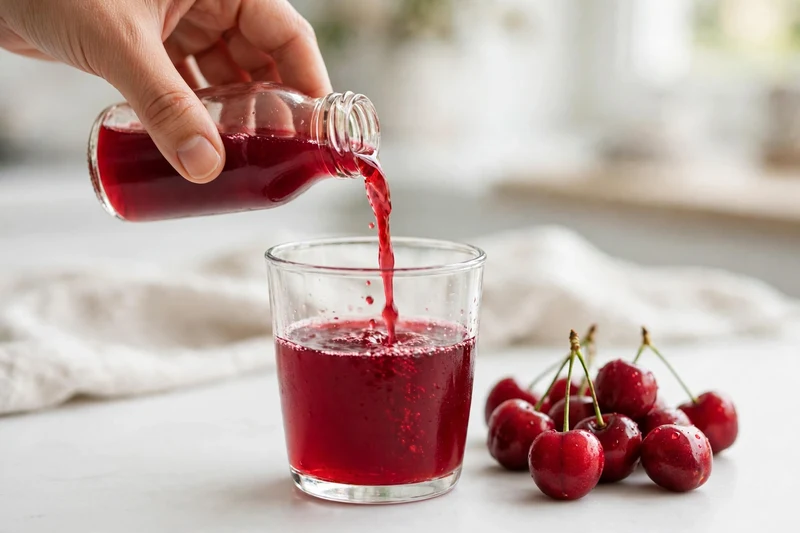
- Tart cherry juice: the 2019 study used 8 ounces of diluted tart cherry juice concentrate daily for four weeks. Choose unsweetened juice – more on why below.
- Tart cherry concentrate: in one comparison, one ounce of tart cherry concentrate (the equivalent of about 90 cherries) lowered uric acid nearly three times as much as 45 fresh cherries.
- Cherry extract: the small 24-patient study used one tablespoon of tart cherry extract – roughly equal to 45 to 60 cherries – twice daily.
The honest summary: concentrated and tart forms deliver a bigger anthocyanin dose per serving, which is probably why they show the clearest effects. Fresh cherries still count, but they give “less bang for your buck,” as the Arthritis Foundation puts it.
The fructose catch you should not ignore
Here is the part cherry fan pages usually skip. Cherries are relatively high in fructose – the same fruit sugar that raises uric acid when it comes from soda or sweetened fruit juice. Fructose is fructose, whether it comes from a cherry or a cola bottle. That is exactly why every serious source specifies unsweetened tart cherry juice: sweetened cherry juice cocktails pile added sugar on top of the fruit’s own fructose and work against the very benefit you are chasing.
This matters most if you have gout alongside diabetes or metabolic syndrome – conditions that already overlap heavily with gout. In that case, cherry supplements or extract avoid the sugar question entirely.
Cherries do not replace gout medication
This is the line the Arthritis Foundation draws, and it is the right one. The American College of Rheumatology recommends uric-acid-lowering drugs like allopurinol for people with frequent flares – currently as few as two attacks a year – and cherries have never been tested head-to-head against allopurinol, so nobody can say how they compare. The Zhang study actually found the strongest effect – 75% fewer attacks – from cherries combined with allopurinol, not instead of it.
Think of cherries as a low-risk addition to your routine, not a substitute for treatment. If your flares are frequent or severe, read our gout symptoms guide and talk to your doctor about uric-acid-lowering therapy – then add cherries to the plan if your doctor agrees.
How to actually use cherries for gout
Until researchers agree on an official regimen – the Arthritis Foundation explicitly says “a specific cherry regimen isn’t advised” yet – here is the practical approach the evidence supports:
- Make it a daily habit, not a rescue remedy. The 2012 study linked cherry intake to fewer attacks in the days afterward, and the juice study ran daily for four weeks. Cherries look like a prevention habit, not a treatment for a flare already raging.
- Go tart and unsweetened for juice. Tart (Montmorency-style) juice and concentrates carry the strongest anthocyanin dose per serving and show the clearest effects in studies. Fresh sweet cherries are fine as a snack too.
- Watch the sugar. Skip sweetened cherry juice cocktails and cherry-flavored drinks – our database flags plenty of those as unmeasured branded products anyway. Unsweetened juice, frozen tart cherries, or extract sidestep the fructose problem.
- Pair cherries with the big levers, not instead of them. Cherries help most inside an overall low-purine plan: plenty of water, low-fat dairy, less beer and fructose-heavy soda. Our article on red meat and gout shows how portion rules work for the foods that actually carry the purines.
- Keep your expectations honest. Cherries lower attack risk by about a third in the best study – meaningful, but not a cure. Diet and lifestyle lower uric acid by roughly 10–15% overall; the rest usually needs medication.
One more honest note: cherries are seasonal and not everyone tolerates them. Coffee shows a similar protective association in large observational studies – our coffee and gout article breaks that one down with the same level of scrutiny. You do not need to force one specific food to get the benefits of a gout-friendly diet.
References
- Zhang Y. et al., “Cherry consumption and decreased risk of recurrent gout attacks,” Arthritis & Rheumatism, 2012 – the landmark 633-patient study: 35% fewer recurrent gout attacks with cherry intake over 2 days, 75% fewer when combined with allopurinol.
- Chen P.-E. et al., “Effectiveness of Cherries in Reducing Uric Acid and Gout: A Systematic Review,” Evidence-Based Complementary and Alternative Medicine, 2019 – review of six studies linking tart cherry juice to lower serum uric acid and fewer, less severe flares, with a call for larger trials.
- Arthritis Foundation, “Cherries May Help Gout Symptoms” – plain-language summary of the anthocyanin research, including the 45-Bing-cherry study, concentrate dosing comparisons, and the fructose and medication caveats.