High Uric Acid: Causes, Symptoms, and What Actually Lowers It
High uric acid — doctors call it hyperuricemia — means your blood carries more uric acid than it should. Most people with high uric acid feel nothing at all. That is exactly why it matters: silent high uric acid is the raw material for gout, kidney stones, and the chalky crystal deposits called tophi. In this pillar guide we cover what high uric acid is, why it happens, which numbers count as high, and the steps that actually bring it down — all grounded in measured food data from our 38,078-food purine database and studies we opened and verified. If you have a recent lab result, read this alongside our guide to uric acid normal ranges for men, women, and kids.
“high uric acid” actually means
Uric acid is a waste product your body makes when it breaks down purines — substances found in your own cells and in certain foods. Blood carries uric acid to the kidneys, which pass most of it into urine so it leaves the body. Mayo Clinic explains that a high uric acid level is simply too much of this waste in the blood. Hyperuricemia is not a disease in itself, and it does not always cause symptoms. It becomes a problem when uric acid stays high enough for crystals to form.
The key number to know is the crystallization line. Above roughly 6.8 mg/dL (about 404 µmol/L), uric acid can form sharp needle-like crystals in joints and tissues. Lab reports, however, define “normal” using population statistics — some labs print upper limits as high as 8.6 mg/dL for men. That gap matters: you can sit inside a lab’s “normal” range and still be above the point where crystals form. Our article on dangerous uric acid levels walks through that gap in detail.
The two ways uric acid runs high
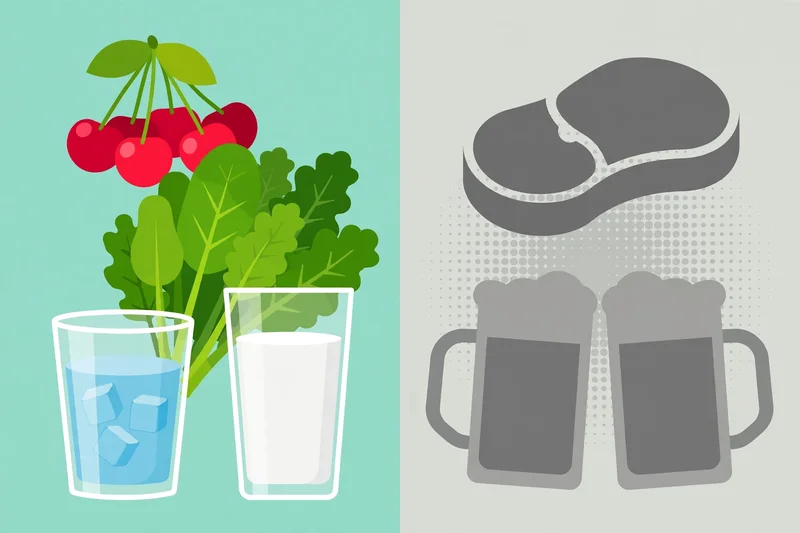
Every case of high uric acid comes down to one of two mechanisms — or both at once. Mayo Clinic puts it plainly: the body makes too much uric acid, does not get rid of enough of it, or both.
1. Your kidneys don’t flush enough (the common one)
This is the dominant cause. Most people with high uric acid are not making dramatically more of it — their kidneys are excreting less. Anything that reduces kidney filtration or increases reabsorption of urate lets levels climb: chronic kidney disease, dehydration, and certain medicines. About three-quarters of excreted uric acid leaves through the urine, so even a small drop in kidney clearance shifts the balance.
2. Your body makes too much
Rapid cell turnover floods the blood with purines from your own tissue. That happens in conditions like psoriasis and some blood cancers, during chemotherapy (tumor lysis syndrome), and with a diet very heavy in purine-rich foods. Obesity also raises production — Mayo Clinic lists obesity and metabolic syndrome as causes, and NHS guidance notes that being overweight both increases uric acid production and reduces how much the kidneys eliminate.
The main causes of high uric acid
The causes group neatly into six buckets. Here is how they stack up, with the food numbers measured, not estimated.
Kidney problems
Any kidney issue that slows filtration lets uric acid accumulate. This is why high uric acid often travels with high blood pressure and metabolic syndrome — the same processes strain the kidneys. If your uric acid is high and your kidney function (eGFR) is slipping, your doctor will want to look at both together.
Diet: purine-rich foods
Food purines contribute a real but limited share of your total uric acid — which is why diet helps but rarely fixes high uric acid alone. The heaviest hitters in our database are the small oily fish and organ meats:
- Dried anchovy: 1,109 mg/100g — the highest measured value in our database
- Raw anchovy: 411 mg/100g; canned anchovy: 321 mg/100g
- Canned sardines: 399 mg/100g
- Beef liver: 197 mg/100g
- Ground beef: 133.3 mg/100g
- Roasted chicken breast: 178.5 mg/100g — not a free pass either
Compare those with the safe end of the scale: 2% milk carries just 0.6 mg/100g and tofu sits at 20 mg/100g. The contrast is the whole strategy — you do not need to guess which foods help and which hurt. Look up any food’s measured purine value here, or follow the swap-by-swap framework on our diet plan page.
Alcohol — especially beer
Alcohol raises uric acid two ways: beer adds purines directly (dark beer measures 13.51 mg/100mL in our database, regular beer about 8.5 mg/100mL), and alcohol metabolism competes with uric acid excretion in the kidneys. Spirits and wine add fewer purines, but they still slow excretion — “less purine” is not the same as “safe”.
Fructose and sugary drinks
This one surprises people. Fructose metabolism burns through ATP in a way that generates uric acid directly — no purines involved. A 12-year prospective study of 46,393 men (Choi & Curhan, published in the BMJ in 2008) found that two or more servings of sugar-sweetened soft drinks per day raised gout risk by 85% compared with less than one serving per month, while diet soft drinks showed no association. Fruit juice counted too, so the point is concentrated fructose, not soda — honestly, purines were never the issue with soda; fructose is. Cutting sugary drinks is one of the highest-leverage single changes you can make.
Medicines
Mayo Clinic’s list includes diuretics (water pills), immune-suppressing medicines, and niacin (vitamin B-3). Several other common drugs shift uric acid too. Never stop or change a prescribed medicine because of your uric acid level — Mayo Clinic stresses keeping every dose unless your doctor tells you otherwise. Bring the reading to your next appointment and ask.
Genetics and family history
Gout and high uric acid run in families. Inherited differences in kidney urate handling are one of the biggest risk factors, which is why two people can eat the same diet and end up with very different numbers. If gout runs in your family, testing your uric acid once — even before any symptoms — is a cheap early-warning step.
Why high uric acid usually has no symptoms
This is the fact almost every top-ranking article buries: most people with high uric acid feel nothing. Mayo Clinic states it directly — most people with high uric acid levels have no symptoms of gout, kidney stones, or related conditions. Symptoms appear only when the excess uric acid turns into something else.
- Gout — sharp crystals form in a joint (the big toe first, classically), triggering sudden severe pain, swelling, heat, and redness. Read why gout strikes the foot first and the full symptoms guide.
- Kidney stones — uric acid crystallizes in the urinary tract, causing severe side or back pain and trouble urinating.
- Tophi — hard, whitish crystal deposits under the skin around joints, elbows, or ears after years of untreated high levels.
Because hyperuricemia is silent, the blood test is the whole early-warning system. Waiting for pain means waiting for damage.
What actually lowers high uric acid
Here is the honest hierarchy of what moves the number, roughly in order of leverage. For the day-by-day version, see our 7 evidence-backed steps to lower uric acid.
1. Know your number and your target
Get a serum uric acid test, note the exact value and units, and compare it against the crystallization line (6.8 mg/dL), not just the lab’s printed range. Our FAQ page answers the testing questions readers ask most.
2. Cut the biggest dietary levers first
You do not need a perfect diet — you need the biggest wins. Swap organ meats and small oily fish (anchovies, sardines) for moderate-purine proteins, drop beer and sugary drinks, and add low-fat dairy: milk at 0.6 mg/100g is one of the safest protein sources measured. Coffee shows a protective association in studies, and adequate water helps the kidneys flush urate. Rebuild meals with the measured values on the diet plan page rather than food lists copied from memory.
3. Lose weight gradually if you carry extra
Weight loss lowers uric acid, but crash diets and high-protein/low-carb crash plans can temporarily raise it as ketones compete with urate excretion. Slow, steady loss — the boring kind — is the kind that works.
4. Keep expectations honest
Diet and lifestyle typically lower uric acid by a modest amount — studies suggest roughly 10–13% — which genuinely matters at the margin but rarely normalizes a very high level on its own. If your reading sits well above the crystallization line, diet is the foundation, not the whole treatment.
5. When medication enters the conversation
For persistent gout, tophi, or repeated flares, guidelines recommend bringing uric acid down to a sustained target — the American College of Rheumatology’s 2020 gout guideline endorses a treat-to-target strategy with a serum urate goal below 6 mg/dL, adjusted upward by your doctor over time. Which medicine, what dose, and when to start are strictly a doctor’s decisions; this article will not name dosages or recommend drugs. What you can do is arrive informed: with your numbers, your family history, and your medicine list in hand.
When to see a doctor promptly
- Your first-ever sudden, severe joint attack — especially with fever, which can signal joint infection
- Signs of kidney stones: severe side or back pain, blood in urine, trouble urinating
- A very high uric acid reading with no symptoms — it still deserves a plan, not a shrug
- You suspect a medicine is raising your level — ask before changing anything
High uric acid is one of the most manageable numbers in medicine precisely because it is measurable, the causes are known, and the fixes are concrete. Test it, know the crystallization line, cut the biggest levers with real food data, and let your doctor handle the rest.
References
- Mayo Clinic — High uric acid level: causes — supports the causes list, the “makes too much or excretes too little” mechanism, and the note that most people with high uric acid have no symptoms.
- Choi HK, Curhan G. Soft drinks, fructose consumption, and the risk of gout in men: prospective cohort study. BMJ. 2008;336(7639):309–312. (MEDLINE abstract, PMID 18244959) — supports the claim that ≥2 servings/day of sugar-sweetened soft drinks raised gout risk 85% vs <1/month, while diet soft drinks showed no association.
- FitzGerald JD et al. 2020 American College of Rheumatology Guideline for the Management of Gout (PubMed 32391934) — supports the treat-to-target urate-lowering strategy with a serum urate goal below 6 mg/dL and the principle that medication decisions belong to the doctor.
- HSE (NHS content) — Gout: symptoms, causes, diagnosis and treatments — supports the lifestyle prevention list (healthy weight, water intake, limiting red meat/seafood/alcohol/sugary drinks) and the causes/risk-factor framing.
For education only — not medical advice. Discuss diet changes with your doctor.