Bread and Gout: Can You Eat Bread With Gout? Real Purine Numbers & the Yeast Myth
Yes, you can eat bread with gout. Bread is low in purines — white bread measures just 12.2 mg per 100 g in our food database — so the loaf itself is rarely the problem. What matters more is the bread you choose and, above all, what you put on it: ham and bacon carry far more purines than any bread.
Is bread high in purines?
No. Bread sits firmly in the low-purine camp. Gout guidance has always put bread, rice and pasta on the “safe” side of the plate, and the measured numbers in our 38,078-food database back that up. White bread measures 12.2 mg of purines per 100 g. A generic bread entry measured in Japan comes in even lower, at 4.4 mg per 100 g, and a crusty baguette measures 15.7 mg per 100 g. For comparison, cooked white rice measures 5.9 mg per 100 g and spaghetti measures 6.8 mg per 100 g — bread is in the same low range as the other staple carbohydrates.
To put those numbers in perspective, look at the foods gout guides actually warn about. Roasted chicken breast measures 178.5 mg per 100 g — roughly fifteen times the purine load of white bread. The gap is the whole story: bread is not what pushes uric acid up. If you are choosing between skipping bread and skipping the processed meat on it, the meat is the far bigger lever.
| Bread or staple | Purines per 100 g | Source in our database |
|---|---|---|
| Bread (no further specified) | 4.4 mg | Measured, Japan |
| White bread | 12.2 mg | Measured, Canada |
| Crusty bread (baguette) | 15.7 mg | Measured, Canada |
| Whole-grain wheat flour | 11.5 mg | Measured, Canada |
| Bread flour | 25.8 mg | Measured, Japan |
| Barley, raw | 44.3 mg | Measured, Japan |
| Buckwheat flour | 75.9 mg | Measured, Japan |
| Spaghetti | 6.8 mg | Measured, Japan |
| White rice, cooked | 5.9 mg | Measured, Canada |
One honest gap: our database has no measured value for a finished whole-wheat loaf, sourdough, rye bread, pita or naan — the branded bread entries are unmeasured. The flour numbers above are the closest measured evidence, and they point the same way: grain-based breads are low in purines. Where we have no measurement, this article says so rather than guessing.
Does the yeast in bread raise uric acid?
This is the most persistent bread myth in gout circles, and it comes from a real number taken out of context. Dried yeast on its own measures a very high 847.1 mg of purines per 100 g in our database. That figure scares people — until you remember that nobody eats dried yeast by the spoonful. Yeast is a small ingredient in a loaf that is mostly flour and water, and the finished product tells the true story: white bread measures just 12.2 mg per 100 g.
Beer is where the yeast confusion usually starts, because beer is genuinely linked to gout. But beer raises gout risk through alcohol and its own purine load, not because bread-style yeast is hiding in it. The Arthritis Foundation notes that beer raises uric acid, while wine in moderation looks less risky — the drink, not the yeast, is the issue. So if you enjoy bread, the yeast in it is not a reason to stop. The same logic applies to sourdough: its long fermentation does not turn it into a purine bomb, even though our database has no measured sourdough value to quote.
Is whole-grain bread better than white bread for gout?
For purines alone, there is little between them. Whole-grain wheat flour measures 11.5 mg per 100 g, slightly below white bread’s 12.2 mg, and refined bread flour measures 25.8 mg per 100 g — all low. The real case for whole-grain bread is not purines at all. It is fiber, fullness and blood-sugar steadiness, which matter because weight and metabolic health are closely tied to uric acid levels.
A large 2025 study gives this some weight. Researchers followed 122,680 people in two long-running US cohorts and found that certain whole-grain foods were linked with lower gout risk: whole-grain cold breakfast cereals at one or more servings a day carried a hazard ratio of 0.62, cooked oatmeal or oat bran at least twice a week a hazard ratio of 0.78, and added bran a hazard ratio of 0.84. But here is the honest nuance the headlines skip: dark breads showed no such association in that study. So whole-grain bread is a sensible, low-purine choice — but it is not, on this evidence, a gout treatment. Choose it for its fiber and for how it keeps you full, not because the loaf itself will lower your uric acid.
That distinction matters because of a finding from the landmark 2004 New England Journal of Medicine study of 47,150 men: purine-rich vegetables were not associated with higher gout risk, while meat and seafood were. Plant purines simply do not behave like animal purines. Bread, as a plant food, sits on the safe side of that line — which is why oatmeal and other grain foods keep showing up as gout-friendly in the research, even when their purine numbers are moderate.
What about sourdough, rye, baguettes and flatbreads?
Baguettes are covered: crusty bread measures 15.7 mg per 100 g, low by any standard. For the rest, we have to be honest about the gaps. Our database has no measured value for sourdough, rye bread, pita, naan, croissants or bagels. That does not make them dangerous — every measured bread and flour sits in the low-to-moderate range — but it does mean any article quoting a precise purine number for sourdough is guessing, and this one will not.
What you can judge is the recipe. A plain flatbread made from flour, water, salt and yeast is nutritionally close to the measured breads. A butter-laminated croissant or a sweetened brioche is a different food: richer, higher in calories and often carrying sugary fillings. The same rule applies to crackers — rice crackers measure 14.2 mg per 100 g, low — but cheese-topped or meat-topped crackers are judged by their toppings, not their base.
If you bake at home, the flour numbers are your guide. Whole-grain wheat flour at 11.5 mg per 100 g and bread flour at 25.8 mg per 100 g both bake into low-purine loaves. Barley flour is a step up at 44.3 mg per 100 g for raw barley, and buckwheat flour is higher still at 75.9 mg per 100 g — still moderate, not red-zone, but worth knowing if you bake with alternative flours. Our food list lets you check any flour or grain before you bake.
What you put on bread matters more than the bread
This is where a gout-friendly sandwich is won or lost. The bread contributes roughly 12 mg of purines per 100 g. The fillings can contribute twenty times that — or almost nothing. Compare:
| Sandwich filling | Purines per 100 g | Verdict |
|---|---|---|
| Butter | Not detected | Low purines, but calorie-dense |
| Mayonnaise | 0.6 mg | Low purines, 680 kcal per 100 g |
| Honey | 0.8 mg | Low purines, but it is fructose |
| American cheese | 7 mg | Low |
| Cottage cheese | 8 mg | Low |
| Tofu (kinu) | 20 mg | Low |
| Boiled egg white | 0.73 mg | Very low |
| Roasted chicken breast | 178.5 mg | Moderate — portion matters |
| Luncheon ham | 250.42 mg | High — processed meat |
| Genoa salami | 246.2 mg | High — processed meat |
| Bacon, cooked | 428.8 mg | Very high |
The pattern is unmistakable. Dairy spreads, egg and tofu fillings keep a sandwich in the low-purine zone. Processed meats blow it up: a ham or salami sandwich carries twenty times the purine load of the bread holding it. And the worst everyday offender, cooked bacon at 428.8 mg per 100 g, is a red-zone food whether it sits on white bread, whole-grain bread or no bread at all.
Honey deserves a special note. At 0.8 mg per 100 g it is nearly purine-free — but honey is fructose, and fructose raises uric acid through a different route than purines. Our soda and fructose article explains that mechanism in full. A drizzle of honey is not a purine problem; a habit of sweet spreads is a fructose problem. The same caution applies to jam and sweetened spreads, for which our database has no measured purine value — judge them by their sugar, not by purines.
Can you eat bread during a gout flare?
Yes. Nothing about bread makes a flare worse, and during a flare you still need to eat. A plain slice of bread with a low-purine topping is one of the easiest safe meals when your appetite is low and your joint hurts. Keep the toppings simple: cottage cheese, egg, or a thin spread of mayonnaise rather than cured meats. Drink water alongside — the Arthritis Foundation suggests at least 8 glasses of non-alcoholic drinks a day, rising to 16 during a flare — and save the rich sandwiches for when the flare has settled.
What to avoid during a flare is not bread but the classic flare companions: beer, large servings of red or processed meat, and sugary drinks. Our diet plan page builds full flare-day menus around exactly this logic — low-purine staples plus safe proteins — and our symptoms guide explains what a flare typically feels like and when to seek care.
How much bread fits a gout-friendly day?
There is no purine-based reason to ration bread tightly. Two slices of white bread weigh roughly 60–70 g, which works out to around 7–9 mg of purines — a rounding error next to a single serving of meat. The reasons to keep portions sensible are calories and balance, not purines: white bread carries 266 kcal per 100 g, and a diet built mostly on refined bread leaves less room for the vegetables, legumes and low-fat dairy that actually help uric acid.
A practical pattern is one to two slices per meal, chosen whole-grain when you can, and paired with low-purine protein. That pattern mirrors the DASH-style eating pattern — high in fruits, vegetables, whole grains and low-fat dairy, low in red and processed meats — that cohort studies link with lower gout risk. If you want a full week built this way, our natural ways to lower uric acid article walks through the levers in order of impact, and our beans guide shows how plant proteins pair with bread for filling, low-purine meals.
Gout-friendly sandwiches that actually taste good
- Egg and cottage cheese: boiled egg white (0.73 mg per 100 g) with cottage cheese (8 mg per 100 g) on whole-grain bread — high protein, low purines.
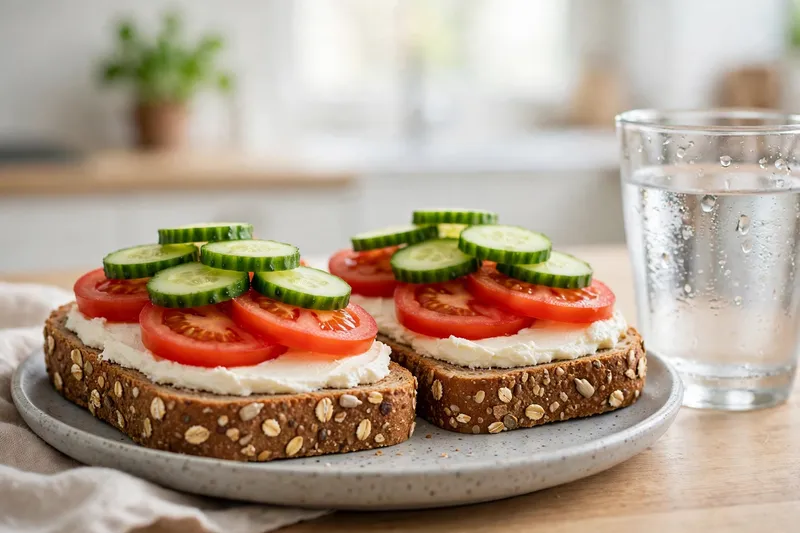
- Tofu and salad: sliced kinu tofu (20 mg per 100 g) with tomato, cucumber and a little mayonnaise (0.6 mg per 100 g).
- Cheese and tomato: American cheese (7 mg per 100 g) with fresh tomato — simple, and the tomato adds vitamin C, which research links with lower uric acid.
- Chicken, kept modest: a thin portion of roasted chicken breast (178.5 mg per 100 g) with plenty of salad — fine occasionally, but the portion is the point.
Skip the deli-counter defaults: luncheon ham (250.42 mg per 100 g), Genoa salami (246.2 mg per 100 g) and cooked bacon (428.8 mg per 100 g) turn an innocent sandwich into one of the highest-purine meals of the day. If you eat them, treat them as rare extras, not daily fillings — and check any food you are unsure about in our purine food chart before it becomes a habit.
So, is bread bad for gout?
No — and that answer holds for white, whole-grain and baguette alike, on measured numbers, not on hope. Bread’s purine load is low, its yeast content does not meaningfully raise uric acid once baked, and whole-grain versions add fiber that supports the broader eating pattern linked with lower gout risk. The one honest caveat from the research is that dark breads themselves did not show a protective effect in the 2025 cohort study — so buy whole-grain bread because it is a better staple, not because it treats gout. Judge every sandwich by its filling, keep processed meats occasional, and bread can stay exactly where it belongs: on your plate.
References
- Rai SK et al., “Long-Term Lignan Intake, Whole Grain Foods, and the Risk of Gout,” Arthritis Care & Research, 2026 — whole-grain cold cereals, oatmeal and bran linked with lower gout risk in 122,680 people; dark breads showed no association.
- Choi HK et al., “Purine-rich foods, dairy and protein intake, and the risk of gout in men,” New England Journal of Medicine, 2004 — meat and seafood raised gout risk; dairy lowered it; purine-rich vegetables did not raise risk.
- Arthritis Foundation, “Gout Diet: Dos and Don’ts” — hydration, low-fat dairy, beer and fructose guidance used for the flare and sandwich advice.
For education only — not medical advice. Discuss diet changes with your doctor.