Oatmeal and Gout: Can You Eat Oatmeal With Gout? Portions, Toppings & Real Purine Numbers
Yes, you can eat oatmeal with gout. No research links oatmeal with a higher risk of gout or gout flare-ups, and gout guides classify it as a moderate-purine food, not a food to avoid. Keep portions sensible, choose plain oats over sugary instant packets, and top your bowl with low-purine foods.
Is oatmeal high in purines?
Oatmeal sits in the middle of the purine scale, and that middle position causes most of the confusion. Gout guides such as Healthline and Verywell Health both describe oatmeal as a moderate-purine food. Verywell Health advises limiting it to no more than two servings a week, with one serving defined as half a cup of cooked oats.
But a laboratory measurement tells a calmer story. A Japanese research team led by Kaneko measured the purine content of common foods and listed oatmeal at 35 mg per 100 g. On that team’s own scale, foods under 50 mg per 100 g count as very low, so oatmeal lands in the lowest band, not the middle. Published figures do vary with the form of oat measured, which is part of why guides hedge with the word “moderate.”
Here is the honest gap in our own data: our 38,078-food database does not have a measured purine value for plain oats or plain oatmeal. The oat entries it holds are branded products marked “not measured.” So this article leans on the published Kaneko measurement and on gout guides, and says so plainly, rather than dressing up a guess as a database number.
One more reason not to panic about the purine label: plant purines do not behave like animal purines. In the landmark Health Professionals Follow-up Study of 47,150 men, researchers found that meat and seafood raised gout risk, while purine-rich vegetables and total protein did not. Oats are a plant food, and that distinction matters more than the raw purine number alone.
How much oatmeal can you eat with gout?
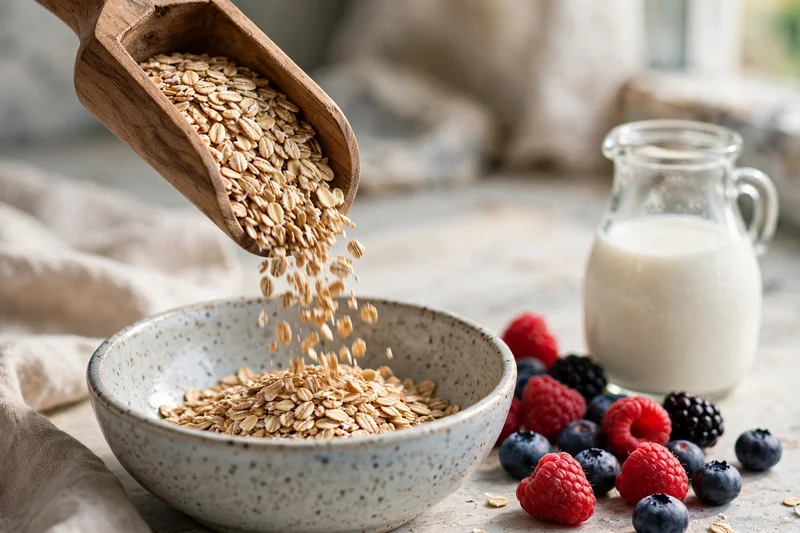
There is no single official serving rule for oatmeal and gout, so treat the guides as a practical starting point rather than a medical limit. Verywell Health’s ceiling of two servings a week, at half a cup of cooked oats per serving, is the most cautious published guidance. Healthline points the other way: it cites a 2025 article that linked a high intake of whole grains, including oatmeal, with a significantly lower gout risk, where “high” meant two or more servings a week.
Those two statements are not as contradictory as they look. Both agree on the same practical zone: a few servings a week of plain oatmeal, in normal portions, is compatible with a gout-friendly diet. What neither supports is eating a giant bowl of sweetened instant oatmeal every single morning and calling it healthy.
A sensible approach looks like this:
- Start with half a cup to one cup of cooked oatmeal per serving, a few times a week.
- Watch the rest of the day’s purine load. A bowl of oatmeal matters far less than the beer, organ meats, or sardines that share the same day.
- Keep your overall diet balanced. Kaneko’s team calculated that well-balanced diets based on dietary guidelines contain roughly 308 to 494 mg of purines per day, close to Japan’s 400 mg per day guideline for people with gout. One bowl of oatmeal is a small share of that total.
- If you notice flares clustering after oatmeal days, talk to your doctor rather than guessing. Food diaries beat food fears.
Remember that diet alone rarely controls gout. As the Mayo Clinic puts it, people who follow a gout diet most often still need medicine to manage pain and lower uric acid. Oatmeal is a supporting player, not a treatment. If you need a reminder of what the condition actually involves, read our guide to gout symptoms and our explainer on the uric acid normal range.
Which type of oats is best for gout?
Steel-cut oats and old-fashioned rolled oats are the best choices. Both are minimally processed, and neither adds sugar or salt. Instant oatmeal packets are the version to watch: the oats themselves are not the problem, but the packets often carry added sugar, and sweetened foods raise uric acid through fructose, not purines. Our article on soda and gout explains why fructose deserves as much attention as purines.
Overnight oats follow the same rule. Soaked in water or low-fat milk with plain toppings, they are just as gout-friendly as cooked oatmeal. Soaked in sweetened yogurt or syrup, they become a dessert wearing a health halo.
Also check the label on oat-based cereals and granola. Many are sweetened, and granola in particular can pack a surprising amount of sugar and oil into a small serving. Plain oats with your own toppings always beat a pre-sweetened mix.
What should you put on oatmeal with gout?
Toppings decide whether your oatmeal helps or hurts. The best toppings are low-purine foods from our verified database, and they also make the bowl taste better:
- Low-fat milk or plain yogurt. Milk with 2% fat measures just 0.6 mg of purines per 100 g in our database, and plain yogurt measures 7 mg per 100 g. Dairy is the one food group that studies link with lower gout risk, not higher. Our guide to milk and gout covers the evidence in full.
- Fresh fruit. Strawberries measure 2.2 mg per 100 g and bananas 3 mg per 100 g. Cherries are a classic gout-friendly topping, and our article on cherries and gout looks at what the studies actually show.
- A small handful of nuts or seeds. Walnuts measure 19.6 mg per 100 g and almonds 31.4 mg per 100 g. Chia seeds measure 58.64 mg per 100 g, so keep the sprinkle small rather than heaped.
- A boiled egg on the side. Egg white measures 0.73 mg per 100 g, making eggs one of the lowest-purine protein foods available.
Toppings to keep small or skip: honey, maple syrup, brown sugar, sweetened yogurt, and dried fruit. Honey itself measures only 0.8 mg of purines per 100 g in our database, but that number misleads. Honey is sugar, and sugar raises uric acid through fructose even when purines are near zero. A teaspoon for taste is very different from three tablespoons stirred in.
Full-fat cream and butter are also worth limiting, not because of purines but because saturated fat works against the weight control that helps gout. Low-fat milk gives you the creaminess with a far better profile.
How does oatmeal compare with other breakfast foods?
Breakfast is where gout diets are won or lost, because the typical Western breakfast can swing from very low to very high purines. Here is how oatmeal compares with common alternatives, using measured values from our database and the published Kaneko figure for oatmeal itself:
| Breakfast food | Purines per 100 g | Verdict for gout |
|---|---|---|
| Oatmeal (published Kaneko measurement) | 35 mg | Fine in normal portions |
| White bread | 12.2 mg | Low, but less fiber than oats |
| Cooked white rice | 5.9 mg | Very low, a safe base |
| Plain yogurt | 7 mg | Low, and dairy may protect |
| Barley, raw | 44.3 mg | Similar middle ground to oats |
| Buckwheat flour | 75.9 mg | Higher than oats, still moderate |
| Peanuts, raw | 49.1 mg | Fine as a small topping |
| Sardines, canned | 399 mg | Red zone, avoid for breakfast |
| Beef liver, raw | 197 mg | Red zone, not a breakfast food |
The table makes the real point: oatmeal is nowhere near the foods that actually drive gout risk. Sardines measure 399 mg per 100 g and dried anchovies 1,109 mg per 100 g. Next to those numbers, an argument over whether oatmeal is “low” or “moderate” is an argument over a small difference. Our red-zone list shows where the real danger sits, and our green-zone list shows the foods you can lean on.
For a full week of gout-friendly meals built on these numbers, see our 7-day gout meal plan. And if you want to check any food yourself, the food list holds the full searchable database.
Does oatmeal lower uric acid?
No honest source claims that oatmeal directly lowers uric acid, and this article will not either. What the evidence supports is subtler and still useful. Whole grains, including oatmeal, appear in every gout-friendly eating pattern: the Mayo Clinic recommends more whole grains as part of a gout diet, and the DASH and Mediterranean patterns that studies link with lower uric acid both lean heavily on whole grains.
Oatmeal helps indirectly in three ways. Its soluble fiber, beta-glucan, supports fullness and steady blood sugar, which helps weight control, and gradual weight loss lowers gout risk. Its fiber supports gut health. And it replaces worse breakfasts: a bowl of plain oatmeal instead of a sugary cereal, a pastry, or a fry-up removes fructose and saturated fat from the day. Those swaps matter more than any single food’s purine count.
One caution cuts the other way. Crash diets and fasting can spike uric acid, so do not turn oatmeal into a starvation plan. Steady, balanced eating beats dramatic restriction every time, and our guide to diet planning for gout shows how to build that balance.
When should you skip oatmeal or ask your doctor?
Most people with gout can eat oatmeal, but a few situations call for a conversation with your clinician. If you have kidney disease as well as gout, your doctor may set stricter limits on potassium, phosphorus, or total purines that change the picture. If you take medication that interacts with high-fiber foods or with specific grains, ask before changing your breakfast routine. And if you have coeliac disease, choose certified gluten-free oats, since ordinary oats can carry traces of wheat.
Also remember that no breakfast choice replaces treatment. If your uric acid stays above target despite a careful diet, or if flares keep coming, that is a medical question, not a menu question. Diet supports treatment; it rarely replaces it.
The bottom line
Oatmeal and gout get along fine. Published measurements put oatmeal at 35 mg of purines per 100 g, guides call it moderate and suggest a few servings a week, and no study links it with more gout. Choose steel-cut or rolled oats, cook them with water or low-fat milk, top them with fruit and a few nuts, and leave the sugar packets behind. That bowl is one of the easiest gout-friendly breakfasts you can make.
References
- Kaneko K et al., “Daily Amount of Purine in Commonly Recommended Well-Balanced Diets in Japan and Overseas,” Nutrients, 2024 — measured oatmeal at 35 mg of purines per 100 g and reports Japan’s 400 mg per day purine guideline.
- Choi HK et al., “Purine-rich foods, dairy and protein intake, and the risk of gout in men,” New England Journal of Medicine, 2004 — in 47,150 men, meat and seafood raised gout risk while purine-rich vegetables and total protein did not.
- Mayo Clinic, “Gout diet: What’s allowed, what’s not” — recommends whole grains and notes that high-purine vegetables do not raise gout risk.
- Healthline, “Oatmeal and Gout: Should You Eat or Avoid?” — describes oatmeal as moderate-purine and notes no research links it with increased gout risk.
For education only — not medical advice. Discuss diet changes with your doctor.