Foods to Avoid with Gout: The Red-Zone List with Real Purine Numbers
If you have gout, you have probably seen a dozen “foods to avoid” lists that all say the same vague things: avoid organ meats, limit seafood, cut the beer. Useful — but vague advice is hard to act on. What counts as “high purine,” exactly? How much worse is liver than a pork chop? And why do sugary drinks make the list when they contain almost no purines at all?
This guide answers those questions with real numbers. Every purine value below comes from our measured purine food database of 38,078 foods — no estimates, no guesswork. Where we don’t have a measured value, we say so plainly.
Why diet matters — and where its limits are
Gout happens when too much uric acid builds up in the blood and forms needle-like crystals in a joint — most famously the big toe. Your body makes uric acid when it breaks down purines, natural compounds found in food and in your own cells. Most uric acid actually comes from your own body, not your plate.
That means food can move the needle, but only so far. Diet changes alone typically lower uric acid by roughly 10–15%. If you have gout or high uric acid, medicine does the heavy lifting — food just stops working against it. Think of diet as the lever you control every single day: it won’t cure gout, but the wrong foods at the wrong time can absolutely tip you into a flare. If you want the full picture, read our guide on what high uric acid is and what actually lowers it.
Also worth knowing: foods hurt you through two different mechanisms. Some pack huge purine loads (organ meats, dried fish). Others are purine-light but block your kidneys from clearing uric acid — beer and fructose-rich drinks fall in this camp. The second group surprises most people, so give it a fair read.
How to read the purine numbers
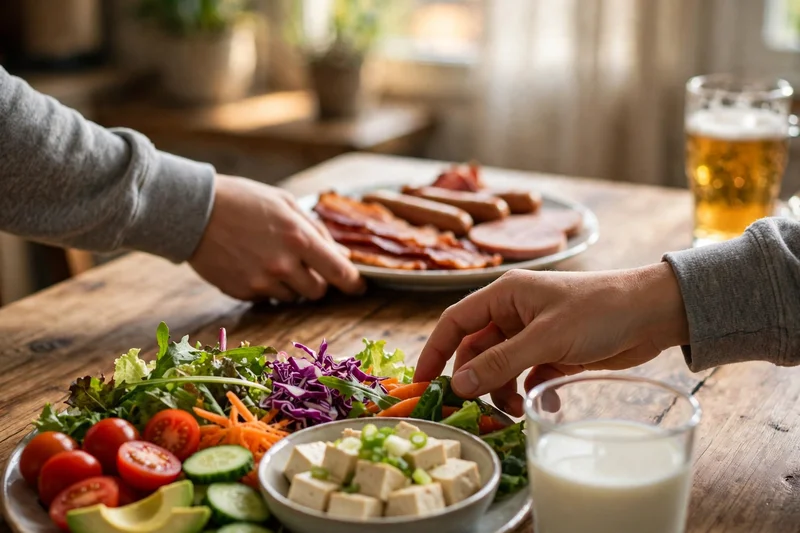
All values below are measured purines per 100 grams (beer is per 100 milliliters). As a rough compass:
- Red zone (avoid): roughly 200 mg/100g and up — one serving can carry more purines than a whole day’s worth of vegetables.
- Amber zone (limit): roughly 100–200 mg/100g — fine occasionally, in small portions, not daily.
- Green zone (enjoy): under about 60 mg/100g.
Compare that to a plain pork chop or a bowl of lentil soup and the list starts to make sense. Now let’s walk through the red zone, group by group.
The red zone, group 1: organ meats
Organ meats are the undisputed champions of purines. Every organ meat we have measured lands in the avoid band:
- Pork liver, raw — 289 mg/100g
- Chicken liver, raw — 243 mg/100g
- Beef kidney, cooked — 230.8 mg/100g
- Beef liver, raw — 197 mg/100g
- Lamb liver, raw — 147 mg/100g (the “lightest” of the bunch, still firmly amber)
One slice of liverwurst on toast can out-purine an entire roast dinner. If you grew up eating liver for the iron, this is the one food group most worth cutting first — the purine-per-bite ratio is simply the worst on the chart.
An honest note: our database doesn’t have a measured purine value for sweetbreads (thymus/pancreas) yet. But sweetbreads are organ meat, and every measured organ meat scores sky-high, so treat them as red zone until measured data says otherwise. The same caution applies to meat extracts and gravies made from them — our database has no measured value for plain gravy either, so we can’t give you a number, but concentrated meat juices are exactly what you would expect to be purine-dense.
The red zone, group 2: small oily fish and dried seafood
Tiny fish carry a big punch. Anchovies and sardines concentrate purines far beyond their size, and drying concentrates them further:
- Anchovy, dried — 1,109 mg/100g (the highest measured value on this entire list)
- Yeast, dried — 847.1 mg/100g (brewer’s/baker’s yeast; see the beer section for why this matters)
- Sardine, baby, dried — 746 mg/100g
- Anchovy, raw — 411 mg/100g
- Sardine, canned — 399 mg/100g
- Herring, canned — 378 mg/100g
- Anchovy, canned — 321 mg/100g
- Mackerel, canned — 246 mg/100g
- Tuna, canned, drained solids — 211.8 mg/100g
Context helps: a small tin of sardines can pack more purines than a steak three times its weight. Dried anchovies — the kind used in Asian stocks and snacks — are in a league of their own at over 1,100 mg per 100g. A landmark 12-year study of 47,150 men found the highest seafood consumers had a 51% higher risk of gout than the lowest consumers (Choi et al., 2004 — see References).
What about shellfish like mussels? Most gout guides flag them, but our database doesn’t have a measured value for plain mussels, so we won’t quote a number. The category-level evidence says keep shellfish infrequent and portions small.
The red zone, group 3: processed and cured meats
This one surprises people. Curing and cooking concentrate purines as water leaves the meat — and our measurements caught one offender that rivals dried fish:
- Bacon, cooked — 428.8 mg/100g
- Luncheon meat, ham — 250.42 mg/100g
- Luncheon meat, turkey — 235.16 mg/100g
- Pork sausage, cooked — 213.2 mg/100g
- Bacon, unprepared — 140.7 mg/100g (note how cooking concentrated it to 428.8)
Yes — even the turkey version of luncheon meat measures over 235 mg/100g. “Turkey” sounds lean and safe; the measurement disagrees. Processed meats also carry the sodium load that goes hand in hand with the other gout risk factors, so cutting them pulls double duty. Our gout diet plan treats all of these as swap-out candidates.
Beer and alcohol: the double-hit problem
Beer looks innocent on a purine chart: regular beer measures just 8.48 mg/100mL and dark beer 13.51 mg/100mL. A whole pint of dark beer carries around 64 mg of purines — less than a single bite of liver. So why does every gout guide shout about beer?
Because alcohol attacks from two sides. First, the purines (beer is brewed with purine-rich yeast — remember dried yeast at 847.1 mg/100g). Second, and bigger: alcohol makes your kidneys hold on to uric acid instead of flushing it out, while its breakdown speeds up uric acid production. You get the load and lose the drain at the same time.
A 12-year study of 47,150 men (Choi et al., Lancet, 2004) found beer had the strongest link to gout of any drink: each 12-ounce serving per day raised gout risk by 49%. Spirits raised risk too (15% per daily drink). Wine showed no increased risk in that study — but that is not a green light, just the least bad finding. During an active flare, skip alcohol entirely; between flares, beer is the one to cut first.
Sugary drinks and fructose: the purine-free trigger
Soda contains almost no purines. Our database has no meaningful purine measurement for sugary sodas at all. Yet fructose-rich drinks belong on every avoid list — because fructose metabolism manufactures uric acid inside your body as it is processed. It’s the purine-free route to the same problem.
The numbers are striking. In a 22-year study of 78,906 women (Choi et al., JAMA, 2010), women drinking one sugar-sweetened soda a day had 74% higher gout risk than those drinking less than one a month — and two or more a day more than doubled the risk (relative risk 2.39). Diet sodas showed no association, so the culprit is the sugar, not the bubbles. Orange juice showed a similar pattern, which is worth knowing if you “drink healthy” with big glasses of juice.
Practical takeaway: swap soda for water or sparkling water, and treat fruit juice as an occasional small glass, not a daily staple. Whole fruit is a different story — fiber slows the fructose hit. Our FAQ page covers the most common drink questions in more detail.
Don’t fear the vegetable drawer
Here is where old-school gout lists went wrong. Spinach, asparagus, cauliflower, and mushrooms all contain moderate purines — and our database confirms it: spinach 51.3 mg/100g, mushrooms 46.9, cauliflower 33, asparagus 32.85. All carry our “safe” status.
More importantly, the 12-year NEJM study found purine-rich vegetables were not linked to higher gout risk at all. Plant purines simply don’t behave like meat purines in the body. The same study found total protein intake had no link to gout either — it’s the source of the protein that matters. So keep the vegetables; drop the liver.
Lentils deserve one honest footnote. Dried raw lentils measure 222 mg/100g — a red-zone number — but that is the weight before cooking, when lentils triple in weight as they absorb water. Cooked lentils are a different food in practice; see our full lentils and gout breakdown for the honest math.
Quick swaps that actually work
Avoid lists only help if you know what replaces each item. These swaps come from our measured database, not from vibes:
- Instead of liver or kidney — chicken breast, roasted (178.5 mg/100g, amber) or, better, plant protein: tofu at 20 mg/100g.
- Instead of sardines and anchovies — the craving is usually for flavor and omega-3s; a smaller portion of a moderate fish, or tofu and nuts for the protein.
- Instead of bacon and luncheon meat — boiled egg white (0.73 mg/100g) or low-fat dairy.
- Instead of beer — water, sparkling water, or coffee (yes, really — see our coffee deep-dive).
- Instead of soda — sparkling water with lemon, or whole fruit.
Notice the pattern: low-fat dairy is the safest protein class in gout research. In the NEJM study, men eating the most dairy had 44% lower gout risk than those eating the least (milk itself measures just 0.6 mg/100g). Our milk and gout article covers exactly why. For the day-by-day mechanics, our diet plan page turns these swaps into meals, and if a flare does break through, our symptoms guide explains what to watch for.
A simple rule for the rest of the week
You don’t need to memorize a table. When you are deciding what to eat with gout, ask three questions:
- Is it an organ meat, a tiny oily fish, or a processed meat? If yes — skip it or keep the portion tiny and rare.
- Does it block uric acid clearance? Beer, spirits, and sugary drinks do — even when their purine numbers look low.
- Am I avoiding something I don’t need to? Vegetables, dairy, and plant proteins earned their place. Don’t make your diet miserable by cutting them.
Diet is one lever among several — hydration, weight, and (when your doctor prescribes it) medication all matter more in absolute terms. But the avoid list is the lever you pull three times a day, and now you know the real numbers behind it. For the offense side of the strategy — what to actively eat — our 7 evidence-backed steps to lower uric acid picks up where this list ends.
References
- Choi HK, Atkinson K, Karlson EW, Willett W, Curhan G. “Purine-rich foods, dairy and protein intake, and the risk of gout in men.” N Engl J Med. 2004;350(11):1093-103. — Supports the meat/seafood risk figures (RR 1.41 and 1.51), the protective dairy finding (RR 0.56), and the claim that purine-rich vegetables carry no increased gout risk.
- Choi HK, Willett W, Curhan G. “Fructose-rich beverages and risk of gout in women.” JAMA. 2010;304(20):2270-8. — Supports the sugary-soda gout risk figures (RR 1.74 for 1/day, 2.39 for 2+/day) and the finding that diet sodas showed no association.
- Choi HK, Atkinson K, Karlson EW, et al. “Alcohol intake and risk of incident gout in men: a prospective study.” Lancet. 2004;363:1277-1281. — Supports the beer finding (49% higher risk per daily 12-oz serving), the spirits finding, the no-link finding for wine, and the dual mechanism of increased uric acid production plus reduced renal excretion.
For education only — not medical advice. Discuss diet changes with your doctor.