How to Stop Gout Pain at Night: Why Flares Strike at 2 AM and What Actually Helps
You go to bed feeling fine. Then, around 2 AM, a pain like nothing else rips you awake — your big toe feels broken, red-hot, and swollen, and even the weight of the duvet on it is unbearable. If this has happened to you, you are not imagining a pattern. A large study of 724 gout patients found the risk of a gout flare was 2.36 times higher overnight (midnight to 8 AM) than during the day — and the link held even for people who drank no alcohol and ate low-purine food in the previous 24 hours (Choi et al., 2015).
Gout flares at night are not just bad luck. There are real reasons your body is more vulnerable after dark — and there are real steps you can take when one strikes. Here is what helps tonight, what to avoid, and how to make tomorrow night calmer.
Why Does Gout Pain Strike at Night?
Gout is inflammation caused by needle-shaped uric acid crystals settling in a joint. Several overnight changes in your body make that crystallization — and the pain it brings — more likely:
- Your body temperature drops during sleep. Uric acid forms crystals more easily at lower temperatures, which is one reason gout loves the cooler extremities. Researchers point to this nighttime cooling as a leading explanation for the pattern.
- You get mildly dehydrated overnight. You go 6–8 hours without water. Less fluid means more concentrated uric acid around the joints — another mechanism the Choi study team flagged.
- Cortisol dips at night. Cortisol is a natural anti-inflammatory, and its levels fall while you sleep. Less cortisol means the inflammatory fire of a flare burns less restrained.
- Pressure and position. Lying on the affected side presses on the joint, and the bedding itself becomes a problem — the classic gout description is that even the weight of a bedsheet is unbearable.
- Possible link with sleep apnea. The researchers noted that interrupted breathing during sleep may raise purine turnover and uric acid levels. If you snore heavily or gasp at night, it is worth mentioning to your doctor.
- Fewer distractions. During the day, your brain has other things to process. At night, alone in the dark, the pain takes center stage — which is one reason it feels so much worse at 3 AM than it would at 3 PM.
Knowing this does two things: it confirms you are not alone, and it points directly at what helps — cooling, elevating, rehydrating, and treating the flare fast.
What to Do Right Now: The Tonight Toolkit
You are awake, it hurts, and you want to sleep again. Work through these steps in order:
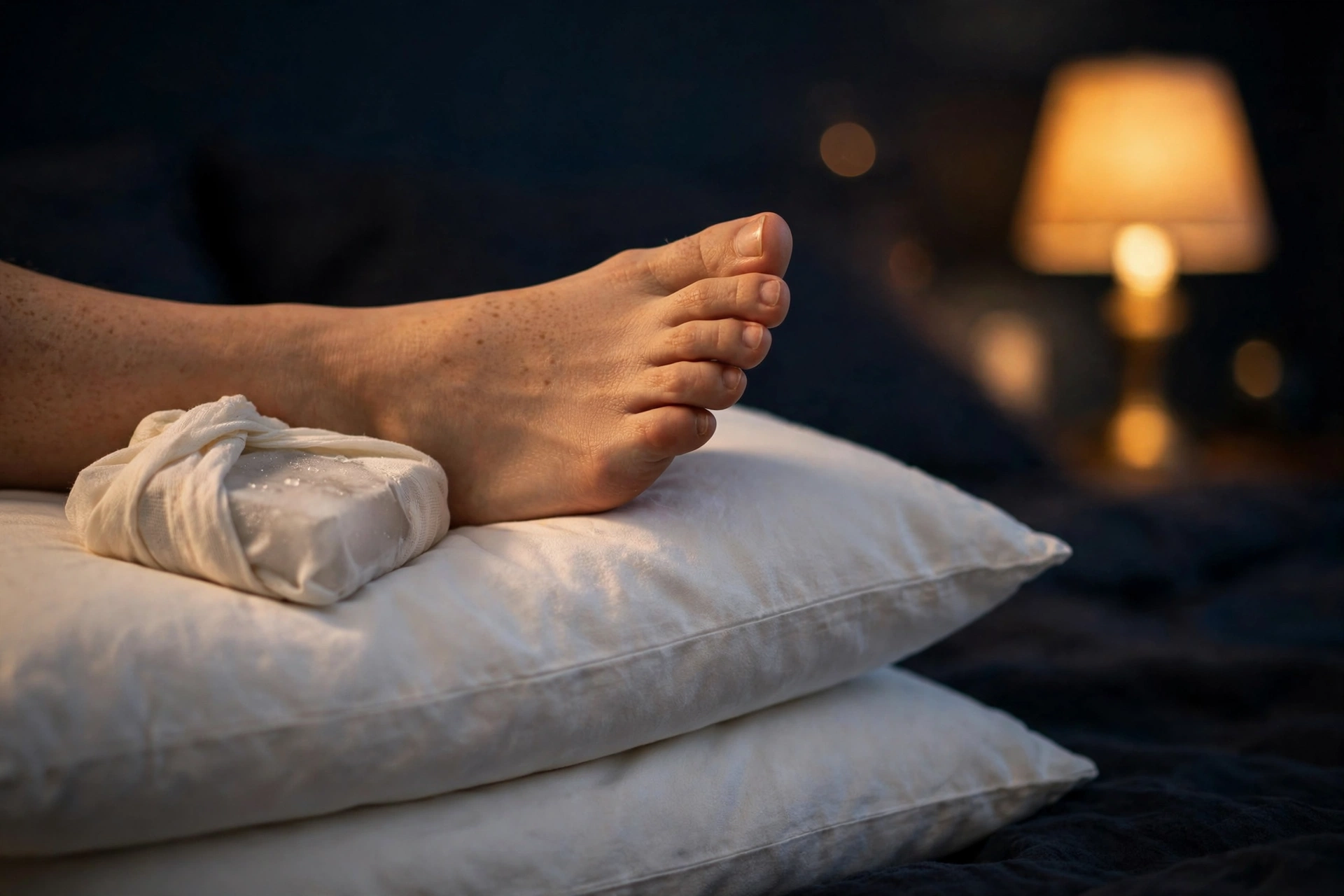
1. Ice the joint — 15 to 20 minutes
Cold narrows blood vessels, slows the inflammatory rush, and numbs the pain. Wrap an ice pack (or a bag of frozen peas) in a tea towel and hold it gently against the joint. Arthritis UK specifically recommends this as a home-management step. Never press ice directly on the skin, and do not wrap it so tightly that it cuts off circulation.
2. Elevate the foot above the rest of your body
Prop the painful foot on two or three pillows. Elevation helps fluid drain away from the joint instead of pooling in it, which eases swelling. This is also why a night flare in the foot feels worse flat on the mattress.
3. Take your doctor-prescribed flare medicine as early as possible
The earlier you treat a flare, the shorter it tends to be. Mayo Clinic lists the standard medicines doctors use for acute gout attacks: NSAIDs (such as ibuprofen or naproxen), colchicine — which works best when taken within 24 hours of the first symptoms — and corticosteroids. If your doctor has already told you which one to reach for at the first sign of a flare, take it now rather than “waiting to see.” Never start a new medicine in the middle of the night on your own — use only what your doctor has approved for you.
4. Get the pressure off the joint
If the duvet’s weight feels like torture, prop it up over the joint with a pillow or roll it back so nothing touches the skin. Take off socks and anything else that presses on the toe or ankle. Rest the joint — do not rub it, massage it hard, or try to “walk it off” tonight.
5. Sip water
A glass or two of water helps counter the overnight dehydration that feeds crystal formation. Do not overdo it to the point of spending the night in the bathroom, but a steady sip while you cool the joint is sensible.
6. Keep the room cool and stay calm
A cool, dark bedroom helps on two fronts: it nudges you back toward sleep, and (counterintuitively for the joint you’re icing) a cooler sleeping environment is part of the recommended bedtime setup for gout sufferers. Slow breathing and staying still give the ice and the medicine time to work.
What NOT to Do During a Night Flare
- Do not use heat. A hot water bottle or warm towel increases blood flow to an already inflamed joint. Cold is the right tool for an acute flare.
- Do not take new or unapproved medicines. At 2 AM it is tempting to swallow whatever is in the bathroom cabinet. Stick to medicines your doctor has specifically approved for your gout attacks — some common painkillers and supplements are not suitable during a flare, so do not experiment while half-asleep.
- Do not walk on it or “tough it out.” Putting weight on an inflamed joint fans the fire. Tonight is for rest and ice, not for pacing the hallway.
- Do not have an alcoholic nightcap to “sleep it off.” Alcohol dehydrates you and raises uric acid production — the exact opposite of what a flare needs.
- Do not massage the joint hard. The inflamed tissue is already irritated by sharp urate crystals. Gentle rest beats firm rubbing.
Set Up Your Night to Hurt Less
You cannot always stop a flare from arriving, but a little preparation makes the next night attack far easier to handle — and some habits lower the odds it starts at all:
- Keep an ice pack in the freezer at all times, with a tea towel nearby to wrap it.
- Keep your prescribed flare medicine and a glass of water on the nightstand — the faster you can treat a flare at 2 AM, the better the outcome.
- Set up an elevation pillow where you can reach it in the dark, so you are not fumbling around while in pain.
- Sleep with loose or no socks and keep heavy blankets off the feet if your big toe is the usual target.
- Skip the big fatty meal and the alcohol close to bedtime. Unusually large meals — especially fatty ones — dehydration, and drinking too much alcohol are all recognized triggers that can shake crystals loose into the joint. Guidance from Versus Arthritis (UK) also suggests keeping a regular bedtime, avoiding caffeine in the 8 hours before sleep, and keeping the bedroom dark, quiet, and a comfortable temperature.
- Do not start or stop urate-lowering therapy on your own. Beginning these medicines — or missing doses — can itself trigger a flare. This is strictly a conversation for your doctor.
Stop the Next Flare Before It Starts
A night attack is often the bill arriving for something earlier that day. The biggest dietary lever is the purine load of what you eat and drink. Our database’s measured values tell a clear story:
- Dark beer measures 13.51 mg/100mL of purines and regular beer 8.48 mg/100mL — plus alcohol blocks uric acid excretion, so beer is a double problem on a flare day.
- Canned sardines measure 399 mg/100g and raw anchovies 411 mg/100g — small oily fish are red-zone purine bombs.
- Beef liver measures 197 mg/100g — organ meats are the highest-purine food class in the database.
- By contrast, 2%-fat milk measures just 0.6 mg/100g and tofu 20 mg/100g — among the safest protein choices we have measured.
Our full foods to avoid with gout guide builds the red-zone list entirely from verified values like these, and the food list lets you look up any of 38,078 foods before you eat it. Beyond diet: keep drinking water through the day (not just at night), and if you keep getting nighttime flares despite eating carefully, ask your doctor about long-term urate-lowering treatment — the 7 evidence-backed steps to lower uric acid walk through what diet can realistically achieve and where medicine takes over. Our diet plan lays out a full gout-friendly eating framework built around these verified numbers.
When to Call a Doctor Right Away
Most night flares can be managed at home with the steps above — but some situations need a doctor urgently:
- Fever plus a hot, red, severely swollen joint. A joint infection can mimic gout and is a medical emergency. Do not assume it is “just gout” when fever is involved.
- The pain is new and you have never had gout diagnosed. A first-ever attack should be properly diagnosed — the symptoms guide explains how gout is confirmed and what it can be confused with.
- The flare ignores your prescribed treatment and the pain is still severe enough to keep you awake — call your doctor rather than doubling medicines on your own.
- Multiple joints flaring at once, or flares that are coming more often and spreading to new joints — a sign the underlying uric acid level needs attention, not just the individual flare.
- It does not behave like your usual gout — the early warning signs guide covers how flares typically start, so you can spot when something is off.
Quick Answers
Why does gout hurt so much worse at night?
A landmark study found gout flares are about 2.4 times more likely between midnight and 8 AM than during the day. Lower body temperature, overnight dehydration, the nighttime dip in the natural anti-inflammatory cortisol, joint pressure from lying down, and plain old lack of daytime distractions all combine to make night the worst shift.
What relieves gout pain the fastest at night?
Ice (15–20 minutes through a cloth), elevation above body level, and your doctor-prescribed flare medicine taken as early as possible. Colchicine, for example, works best within 24 hours of the first symptoms — waiting until morning costs you hours of that window.
Should I stay in bed or get up and move with gout pain?
Rest the joint tonight. Gentle movement has its place on ordinary days, but during an active flare — especially at night — keeping weight and pressure off the joint and icing it is the priority.
How long will a night flare last?
Untreated flares often peak within 12–24 hours and can drag on for days. Treating it fast — ice, elevation, and medicine at the first sign — is the most reliable way to shorten it.
References
- Choi HK, Niu J, Neogi T, et al. Nocturnal Risk of Gout Attacks. Arthritis & Rheumatology. 2015;67(2):555–562. — The case-crossover study of 724 patients that found gout flares 2.4 times more likely overnight; proposed causes include lower body temperature, nighttime dehydration, the nocturnal cortisol dip, and sleep apnea.
- Versus Arthritis (UK). Gout: Symptoms, causes and treatment. — Confirms attacks often strike at night (often in the big toe, where even a bedsheet’s weight is unbearable); recommends ice packs and resting the joint as home management.
- Mayo Clinic. Gout – Diagnosis and treatment. — Details the medicines used for acute flares (NSAIDs, colchicine best taken within 24 hours of symptom onset, corticosteroids) and long-term urate-lowering options.
For education only — not medical advice. Discuss diet changes with your doctor.