Tomatoes and Gout: Do Tomatoes Raise Uric Acid? What the Research Actually Shows
Short answer: For most people with gout, fresh tomatoes are fine. They measure just 3.1 to 6.6 mg of purines per 100 g in our food database — far below red meat and oily fish — and major gout guides do not list tomatoes as a food to avoid. One well-known study did find a small link between tomato eating and slightly higher uric acid, but the effect was tiny, and the study’s own authors say it cannot prove tomatoes trigger flares.
Why do people think tomatoes cause gout flares?
Tomatoes have a reputation as a gout trigger that goes back a long way. Many people with gout will tell you they avoid tomatoes, and the idea has spread through patient forums and old diet lists. Tomatoes are also nightshades, a plant family that includes potatoes, eggplant, and peppers, and nightshades have long carried a vague reputation for worsening joint pain — even though the evidence for that claim in gout specifically is weak.
There is, however, one real study behind the reputation. In 2015, researchers at the University of Otago in New Zealand surveyed 2,051 people with clinically confirmed gout and asked which foods and drinks they believed triggered their flares. Tomatoes came in fourth: 20.2% of those who reported any trigger named tomatoes, behind seafood and fish (62.5%), alcohol (47.1%), and red meat (35.2%). That is a striking result — one in five people with a trigger blamed tomatoes — and it is why this question deserves a careful answer rather than a dismissal.
But a self-reported trigger is not proof. People naturally blame the last unusual thing they ate before a flare, and flares often arrive days after the food that may have contributed. The Otago team knew this, so they tested the idea a second way: they pooled dietary and blood-test data from 12,720 people in three long-running US health studies and checked whether people who ate more tomatoes actually had higher uric acid.
What the Otago study actually found
The pooled analysis did find a statistically significant association: each additional serving of tomatoes per week was linked to a 0.66 micromol per litre (µmol/L) rise in serum urate, with a p-value of 0.006. The effect appeared in both men (0.84 µmol/L) and women (0.59 µmol/L).
Those numbers sound scientific, but what do they mean in everyday units? Converted, 0.66 µmol/L is about 0.011 mg/dL — roughly one hundredth of a point on the mg/dL scale most people see on their lab report. To put that in context, the crystallization point where urate starts forming crystals is around 6.8 mg/dL, and treatment guidelines aim to keep levels below 6 mg/dL. A shift of 0.011 mg/dL per extra weekly serving is real in a statistical sense and negligible in a practical one. Even eating seven extra servings a week would be associated with a rise of under 0.1 mg/dL.
Most importantly, the researchers themselves drew a careful line. They wrote that their descriptive and observational data “are unable to support the claim that tomato consumption is a trigger of gout attacks,” while noting that the small association gives the self-reports “a biological basis.” In plain words: tomatoes may nudge uric acid up very slightly, but this study does not show that eating tomatoes causes flares.
That distinction matters, because the top-ranking articles on this topic tend to blur it. Some present tomatoes as a proven trigger; others wave the study away entirely. Neither is quite right. The honest position sits in the middle: a small, real association, far too small on its own to explain a flare, and no proof of cause and effect.
How many purines do tomatoes actually contain?
Here is where our own food database settles the biggest part of the question. Purines break down into uric acid, so a food’s purine load is the first thing to check. Our database of 38,078 foods gives these measured values for tomatoes:
| Tomato form | Purines per 100 g | Source |
|---|---|---|
| Cherry tomatoes, raw | 3.1 mg | Measured, Japan |
| Tomatoes, no further specified | 6.6 mg | Measured, Japan |
Compare those numbers with the foods gout guides agree on as genuine problems, all from the same database:
| Food | Purines per 100 g |
|---|---|
| Anchovies, raw | 411 mg |
| Sardines, canned | 399 mg |
| Beef liver, raw | 197 mg |
| Chicken breast, roasted | 178.5 mg |
| Tomatoes, no further specified | 6.6 mg |
| Cherry tomatoes, raw | 3.1 mg |
| Milk, 2% fat | 0.6 mg |
Fresh tomatoes sit at the very bottom of this scale — roughly 30 to 60 times lower in purines than sardines or anchovies, and lower than chicken breast by a factor of about 27. Even beer, which raises gout risk mainly through alcohol rather than purines, measures 8.48 mg per 100 mL for regular beer and 13.51 mg per 100 mL for dark beer — still above a fresh tomato. On purines alone, there is simply no case for treating a fresh tomato like a red-zone food. If you want the full red-zone picture, our guide to foods to avoid with gout lists the real high-purine foods with their measured numbers.
One honest gap: our database does not have a measured purine value for tomato paste, tomato sauce, ketchup, tomato juice, sun-dried tomatoes, or canned tomatoes — only branded products marked “not measured.” That does not mean those products are high in purines; it means we cannot put a number on them, and we will not guess. What we can say is that processing concentrates whatever is in the tomato, and that sweetened products such as ketchup carry added sugar — and sugar, especially fructose, is a proven uric-acid raiser. Our article on soda, fructose, and gout explains that mechanism in detail. With ketchup and sweetened sauces, the sugar is a far bigger concern than the tomato.
Why might tomatoes nudge uric acid up at all?
If tomatoes are so low in purines, why did the Otago study find any association? The researchers proposed a candidate explanation: tomatoes are rich in glutamate, an amino acid that is also abundant in purine-rich foods. Glutamate may stimulate the pathways that produce uric acid. This is a hypothesis, not a proven mechanism — it has not been confirmed by intervention trials in which people are fed tomatoes and their uric acid is tracked. Treat it as a plausible lead, not a fact.
There are also simpler explanations that the study design cannot rule out. People often eat tomatoes with the foods that genuinely raise uric acid: pizza topped with processed meat and cheese, pasta with meat sauce, burgers with fries. When a flare follows a tomato-rich meal, the tomato may be taking the blame for its company. Recall bias plays a role too — after a painful flare, the most memorable recent meal gets blamed, whether or not it caused anything.
Finally, gout flares are not a simple function of one meal. Uric acid crystals build up over months, and a flare can be set off by dehydration, illness, surgery, alcohol, or starting uric-acid medication, even when the last meal was harmless. Our guide to gout in the foot describes how flares develop and why timing can mislead.
What do the major gout guides say about tomatoes?
Neither of the two most widely used gout diet guides lists tomatoes as a food to avoid. The Mayo Clinic’s gout diet guide says studies have shown that vegetables high in purines — it names asparagus and spinach — do not raise the risk of gout, and its list of foods to limit is headed by organ meats, red meat, most seafood, and alcohol. The Arthritis Foundation’s gout diet guide likewise encourages vegetable proteins and says they do not raise uric acid levels and may even protect against attacks; its “don’t” list covers beer, liquor, soda, organ meats, and certain seafood. Tomatoes appear on neither avoid list.
That lines up with the broader evidence on plant purines. Large studies have repeatedly found that purine-rich vegetables and legumes do not increase gout risk the way animal purines do. Tomatoes, at 3.1 to 6.6 mg per 100 g, are not even a high-purine vegetable — compare spinach at 51.3 mg per 100 g for mature raw leaves, eggplant at 50.8 mg per 100 g, and mushrooms at 46.9 mg per 100 g, all of which are still considered safe in a gout diet. If spinach and mushrooms pass, a tomato passes comfortably.
Are tomatoes good for gout, then?
It would be an overcorrection to call tomatoes a gout treatment. No study shows that eating tomatoes lowers uric acid or prevents flares. What can fairly be said is that tomatoes are a low-purine, nutrient-dense food that fits well into the eating pattern gout guides recommend: plenty of vegetables, low-fat dairy, whole grains, and limited alcohol and sugary drinks. They are rich in vitamin C, and vitamin C in higher amounts has been linked in studies to lower uric acid — though a tomato alone will not supply a therapeutic dose, and vitamin C supplements are a separate question to discuss with your doctor.
The practical value of tomatoes is simpler: they make low-purine meals taste good. A salad, a vegetable soup, or a tomato-based sauce over rice and beans is a meal you will actually want to eat again, and a diet you enjoy is one you can sustain. Our diet plan page builds meals around exactly that kind of vegetable-forward plate, and our food list lets you check the purine numbers of hundreds of other foods the same way.
How to test whether tomatoes are a trigger for you
Population averages cannot settle a personal question. About one in five people with a reported food trigger in the Otago survey named tomatoes, and even if the average effect is tiny, individual responses vary. If you suspect tomatoes, do not guess — test it for a few weeks:
- Keep a simple food and flare diary. Note what you ate, roughly how much, and when any flare starts. Two or three weeks of notes beat memory every time.
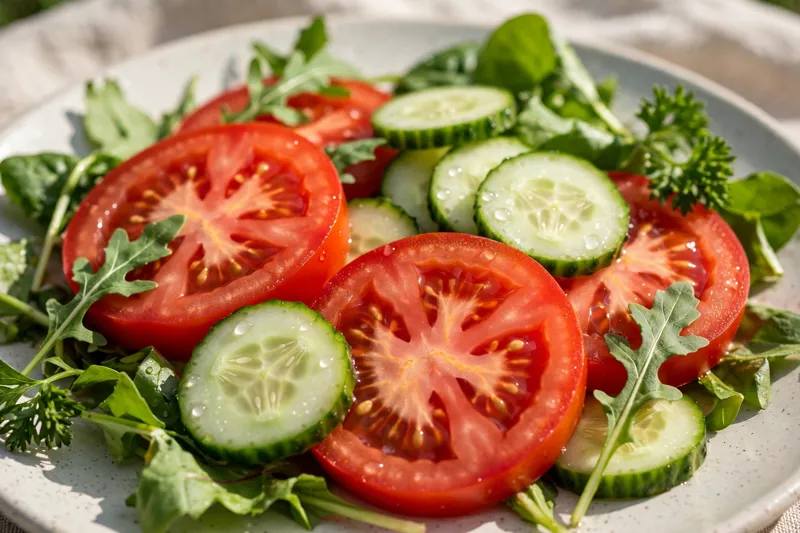
- Separate the tomato from its company. A flare after pizza is not evidence about tomatoes. Test plain tomatoes — sliced in a salad, for example — on their own before judging.
- Look for a pattern, not a single event. One flare after tomatoes proves nothing; flares happen for many reasons. Repeated flares that follow tomato-heavy days, with no other trigger in sight, are worth taking seriously.
- Check the usual suspects first. Alcohol, dehydration, a rich meat-heavy meal, illness, or a recent medication change are all stronger, better-proven flare triggers. Our article on how to lower uric acid covers the levers with the strongest evidence.
- Do not cut out a whole food group on a hunch. If tomatoes turn out to be a genuine personal trigger, swap them rather than losing vegetables altogether — cucumber (9.4 mg per 100 g), carrots (2.1 mg per 100 g), onions (2.2 mg per 100 g), green beans (7.5 mg per 100 g), and potatoes (6.5 mg per 100 g) are all measured low-purine options from our database.
If you do identify a personal trigger, tell your doctor. A food diary is genuinely useful information at a clinic visit, and it helps distinguish a dietary trigger from a treatment problem — for example, a uric acid level that needs medication rather than menu changes. If you are unsure what your level means, our guide to the uric acid normal range explains the numbers for men, women, and children.
Tomato products: where to be careful
Fresh tomatoes and processed tomato products are not the same question. Here is how to think about each:
- Fresh tomatoes, cherry tomatoes, and plain canned tomatoes: low purines, no reason to avoid for most people. Rinse canned tomatoes if you are watching salt, since sodium matters for blood pressure, which often travels with gout.
- Plain tomato sauce and passata: no measured purine value in our database, but made from the same low-purine fruit. Check the label for added sugar.
- Ketchup and sweetened barbecue-style sauces: the concern is added sugar and fructose, not the tomato. Use sparingly, as you would any sweetened sauce.
- Tomato juice and tomato-based cocktails: no measured purine value in our database. Watch the salt content and any added sugar, and remember that juices in general concentrate fructose compared with whole fruit.
- Sun-dried tomatoes: no measured purine value in our database. Drying concentrates everything per 100 g, so portions are naturally smaller — a tablespoon in a salad is a different matter from a whole bowl.
And one caution that applies to any food claim: if a sauce, soup, or ready meal lists yeast extract among its ingredients, that ingredient can carry very high purines (above 200 mg per 100 g in some products). That is a reason to read labels on packaged tomato soups, not a reason to fear a fresh tomato.
The bottom line
Fresh tomatoes are a low-purine food — 3.1 mg per 100 g for cherry tomatoes and 6.6 mg per 100 g for tomatoes generally in our measured database — and neither the Mayo Clinic nor the Arthritis Foundation lists them as a food to avoid. The single best study on the question found a tiny association with higher uric acid, about 0.011 mg/dL per extra serving per week, and its authors explicitly said it does not prove tomatoes trigger flares. For most people with gout, there is no good reason to give up tomatoes. If you are one of the minority who notices a repeatable pattern, a short food diary will tell you more than any blanket ban — and swapping in other low-purine vegetables keeps your meals enjoyable either way. If you have questions about symptoms or your own levels, our symptoms guide and FAQ page are good next stops.
References
- Flynn TJ, Cadzow M, Dalbeth N, et al. Positive association of tomato consumption with serum urate (BMC Musculoskeletal Disorders, 2015) — the Otago survey of 2,051 gout patients and the 12,720-person pooled analysis behind the 0.66 µmol/L finding.
- Mayo Clinic — Gout diet: What’s allowed, what’s not — high-purine vegetables do not raise gout risk; foods to limit are organ meats, red meat, most seafood, and alcohol.
- Arthritis Foundation — Gout Diet: Dos and Don’ts — vegetable proteins do not raise uric acid and may protect against attacks; tomatoes are not on the avoid list.
For education only — not medical advice. Discuss diet changes with your doctor.